

The UK Gambling Market in Numbers
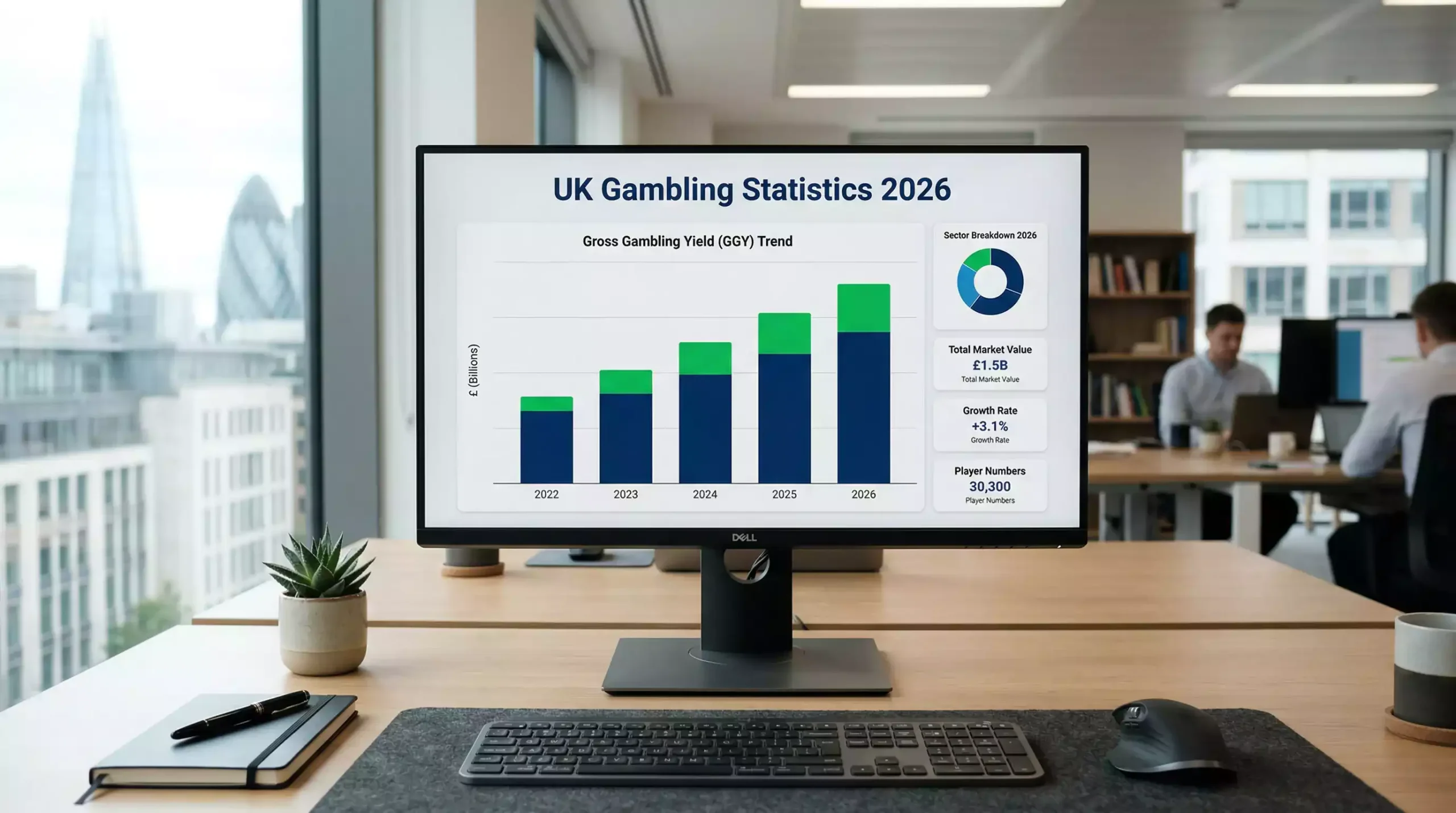
Over £14 billion in gross gambling yield — the UK is one of the world’s largest regulated gambling markets by any measure. That headline figure, representing the total revenue retained by operators after winnings are paid out, places the UK alongside the United States and Macau in scale, while operating under a regulatory framework that is substantially more unified than either. Every pound of that yield was generated within a licensing system overseen by a single regulator, the UK Gambling Commission, across a market that spans sports betting, casino games, bingo, poker, lotteries, and machine gaming.
The sector breakdown reveals where the money actually flows. Remote gambling — the UKGC’s term for online — accounts for the largest share of total GGY, having overtaken the retail sector several years ago. Within the remote segment, betting holds the dominant position, driven by football wagering and horse racing. Casino products, including slots and live dealer games, form the second-largest online category, with slots alone generating more revenue than several other verticals combined. Bingo, poker, and other products contribute smaller but stable shares.
The retail sector — bookmaker shops, casinos, bingo halls, and arcades — has been contracting gradually for over a decade. The combination of the 2019 FOBT stake limit reduction, shifting consumer preferences toward online play, and the operational disruptions of the early 2020s accelerated a structural decline that was already underway. High street bookmaker shop numbers have fallen significantly from their peak, and the trend shows no sign of reversing. Physical casinos and bingo halls have proven more resilient, partly because their appeal rests on a social experience that online platforms replicate imperfectly.
The gambling levy, introduced as a mandatory charge on operators to fund research, prevention, and treatment of gambling harm, now generates a dedicated revenue stream that replaced the previous system of voluntary contributions. The levy is calculated as a percentage of GGY, ensuring that the funding available for harm reduction scales with the market’s own growth. This structural change addresses one of the long-standing criticisms of the UK regulatory model: that the industry’s financial contribution to harm prevention was voluntary, inconsistent, and inadequate relative to the revenue being generated.
Tax revenue from the gambling sector flows through the point-of-consumption framework introduced in 2014 and subsequently adjusted. Remote gambling operators pay tax on the gross profits generated from UK customers, regardless of where the operator is based. The revenue generated for the Exchequer is substantial — several billion pounds annually across all gambling duties — making the sector a meaningful contributor to public finances and creating a fiscal incentive for the government to maintain a regulated rather than prohibitionist approach.
Who Gambles in the UK: Participation Rates and Demographics
According to the Gambling Commission’s most recent participation data, around 47–48% of UK adults reported gambling in the past four weeks. That figure has remained broadly stable over recent years, though the composition of gambling activity has shifted — fewer people using retail products, more using online platforms, and a notable increase in the proportion of gambling conducted via mobile devices.
The National Lottery remains the most widely used gambling product in the UK, accounting for a significant proportion of that participation rate. When lottery products are excluded, the participation rate drops to around 28%, reflecting the fact that many people who buy a lottery ticket don’t consider themselves gamblers and don’t engage with any other gambling product. This distinction matters when interpreting participation statistics: the headline figure includes a large population of occasional lottery players alongside regular sports bettors, casino players, and bingo participants.
Age distribution patterns are well established. Gambling participation rates peak among the 25-to-44 age group for online products and among the 45-to-64 group for retail products. The youngest adult demographic — 18 to 24 — shows lower overall participation but higher engagement with online and mobile platforms where they do participate. The UKGC’s regulatory focus on protecting younger adults, including the lower £2 stake limit for 18-to-24-year-olds on online slots, reflects evidence that this age group is more susceptible to gambling harm relative to their level of participation.
Gender patterns differ markedly by product type. Sports betting participation is overwhelmingly male. Bingo participation is more evenly split, with a slight female majority. Casino games skew male but less dramatically than sports betting. National Lottery participation is roughly equal between genders. These patterns have been consistent over time, and the industry’s marketing strategies — both in terms of advertising placement and product design — reflect and reinforce them. The UKGC’s advertising restrictions, including the ban on imagery and personalities that appeal primarily to under-18s, have been supplemented by closer scrutiny of targeting practices that disproportionately reach vulnerable demographics.
Problem gambling prevalence, as measured by the Problem Gambling Severity Index (PGSI), shows approximately 2.7% of the adult population scoring 8 or more (indicating problem gambling), with a further 3.1% classified as moderate-risk and 8.8% as low-risk. In absolute numbers, this represents hundreds of thousands of people experiencing serious gambling-related harm. Note that earlier surveys using the DSM-IV methodology reported lower rates of 0.3–0.5%, but this is not directly comparable due to methodological differences.
Online Gambling Growth: Trends and Projections
Online gambling now accounts for over 40% of total GGY in the UK market, and that share continues to grow. The trajectory has been consistent for over a decade: each year, a larger proportion of total gambling revenue shifts from retail to remote channels. The acceleration caused by the temporary closure of physical venues in 2020 and 2021 created a step change that was only partially reversed when retail reopened. Many players who migrated to online platforms during that period didn’t return to their previous habits. The convenience, game variety, and accessibility of online gambling proved stickier than the industry expected.
Mobile is the dominant access channel within the online segment. Over 70% of online gambling activity in the UK now occurs on smartphones and tablets, with the proportion highest among sports bettors using native apps for in-play wagering. The mobile share has implications beyond access convenience. Mobile sessions tend to be more frequent but shorter than desktop sessions. The user experience on a 6-inch screen is fundamentally different from a desktop browser — it favours simpler interfaces, faster interactions, and products designed for portrait orientation. Operators that have optimised their mobile experience report higher engagement metrics across every measurable dimension.
Within the online segment, specific verticals are growing at different rates. Live casino has been the fastest-growing product category at UK sites, driven by Evolution Gaming’s expansion of game show titles and the general appeal of real-dealer interaction in a format that’s accessible from home. Sports betting remains the largest online vertical by revenue but is growing more slowly, partly because the market is mature and partly because the regulatory changes to advertising and promotion have constrained some of the acquisition channels that previously drove growth. Slots revenue remains substantial but faces headwinds from the stake limits and autoplay ban introduced in 2025.
Emerging verticals — esports betting, virtual sports, and social gaming with gambling-adjacent mechanics — occupy a small but growing niche. Esports betting has a dedicated audience among younger demographics and is expected to grow as the competitive gaming ecosystem matures in the UK. Virtual sports — algorithm-generated events with short cycles and continuous availability — have found a market among bettors who want the structure of sports wagering without waiting for real-world fixtures. The regulatory treatment of these products is still evolving, with the UKGC monitoring developments to ensure that novel formats are captured within the existing licensing framework.
Numbers Don’t Lie — But They Don’t Tell the Whole Story
Market growth doesn’t automatically mean more harm. This is the nuance that raw statistics often obscure, and it matters because the policy debate around UK gambling frequently collapses into a binary: either the market is growing and harm is increasing, or the market needs to shrink to reduce harm. The evidence is more complex than either position allows.
A growing market with a stable problem gambling rate means that the absolute number of problem gamblers may increase — more people gambling means more people in the at-risk tail of the distribution, even if the proportion stays the same. But a growing market with a strengthened regulatory framework, better-funded treatment services, and more effective intervention tools may contain that growth in harm more effectively than a smaller market with weaker protections. The UK’s approach since the Gambling Act Review has been to pursue the second path: allow the legal market to operate while tightening the regulations that govern how it operates. The results will be measured in prevalence data over the coming years.
Revenue figures also mask distributional questions. The aggregate GGY of £14 billion-plus doesn’t distinguish between revenue generated from recreational players who gamble within their means and revenue generated from players who are spending beyond theirs. Industry critics have argued that a disproportionate share of gambling revenue comes from a small percentage of high-spending customers, some of whom may be experiencing harm. The affordability checks introduced in 2025, triggered at the £150 net-spend threshold, represent the UKGC’s attempt to address this concentration by intervening at the point where spending patterns may indicate vulnerability.
The statistics are essential context for anyone gambling in the UK or evaluating the market. They confirm the scale, the structure, and the trends. They identify who participates and how. They quantify the harm that exists within the market and the resources now directed at addressing it. What they don’t do is make judgements. A £14 billion market is neither good nor bad in itself. Whether it’s serving its customers well — providing entertainment to those who seek it while protecting those who need protection — depends on the regulatory infrastructure around it and the behaviour of the operators within it. The numbers measure the market. The regulation determines whether the market works.
Stay informed at top10gamblingsites-uk. Also read our UK gambling laws.