

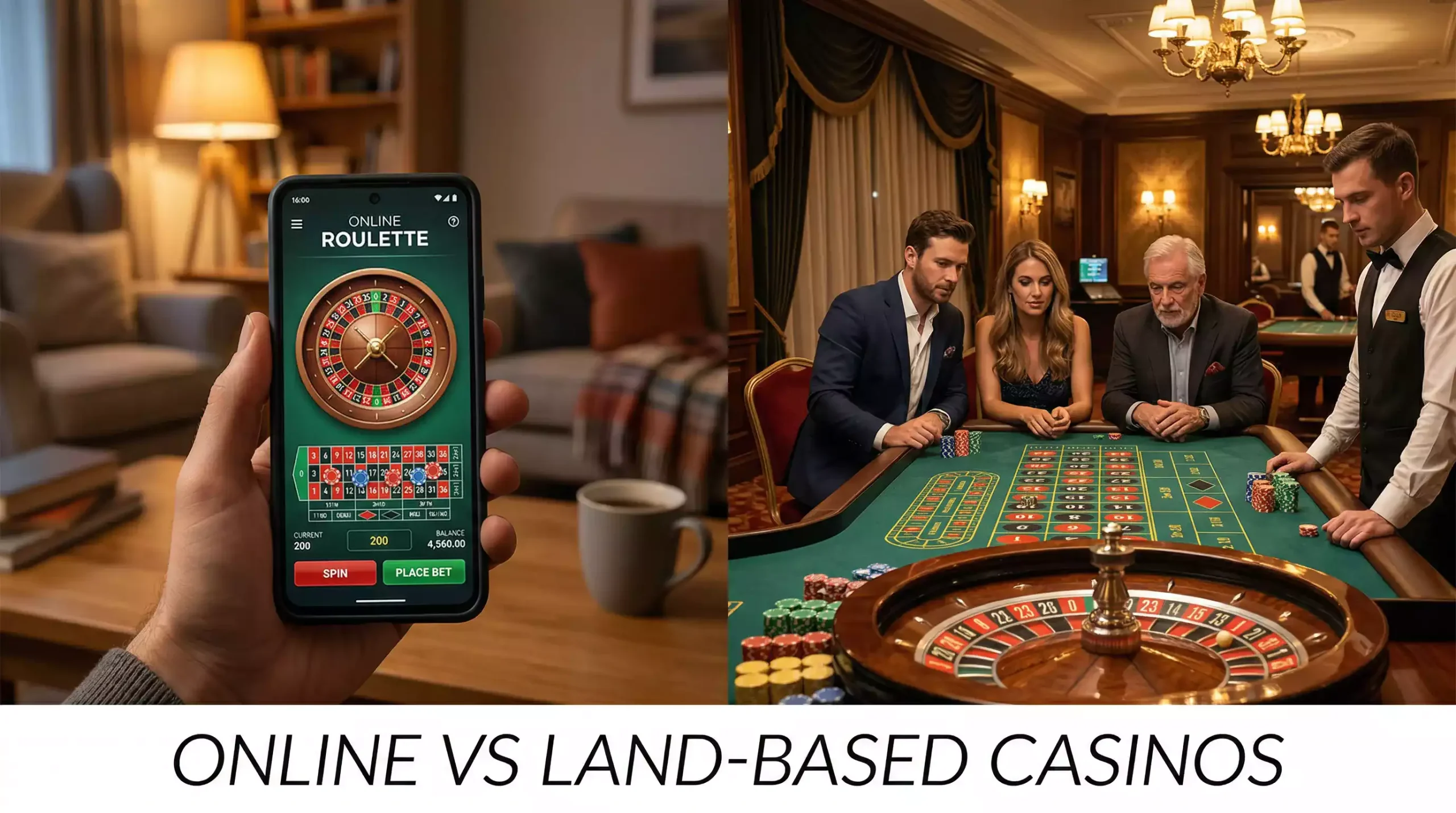
Two Ways to Gamble — Different Experiences, Same Regulation
Both online and land-based gambling are UKGC-regulated — the experience is where they diverge. This is worth stating at the outset because the comparison is sometimes framed as if one format is legitimate and the other isn’t, or as if the regulatory protections available in a physical casino somehow don’t apply online. They do. A UKGC remote operating licence imposes obligations on an online operator that are structurally equivalent to those imposed on a land-based casino licence holder: game fairness testing, fund protection, responsible gambling tools, complaints procedures, anti-money laundering compliance, and advertising standards. The regulatory floor is the same. What differs is everything built on top of it — the atmosphere, the game selection, the pace, the social context, and the practical experience of sitting in a physical space versus using a screen.
The UK is one of the few markets where both formats coexist at scale within a unified regulatory framework. The country has around 130 licensed land-based casinos, several thousand bookmaker shops, hundreds of bingo halls, and over two hundred licensed remote operators. A UK player choosing how to gamble has genuine options across both formats, and the choice is not trivial — the experiences are different enough that the same person might prefer online for some products and land-based for others.
The comparison that follows is not an argument for one format over the other. It’s a practical assessment of what each delivers across the dimensions that matter to players: game variety, return rates, accessibility, social experience, bonuses, payments, responsible gambling tools, and atmosphere. The goal is to help you decide which format — or combination — suits how you actually want to gamble, rather than defaulting to whichever you encountered first.
Online vs Land-Based: Feature-by-Feature Comparison
Here’s what each option delivers across the categories that determine the actual playing experience. The differences are larger than casual comparison suggests, and they compound across every session.
Game variety is the most dramatic point of divergence. A mid-sized UKGC-licensed online casino offers between two thousand and five thousand game titles. The largest sites exceed ten thousand. A physical casino in the UK operates with a few dozen table positions and a gaming floor of perhaps one hundred to two hundred slot machines. The maths is straightforward: online platforms can host unlimited titles because the marginal cost of adding a game is negligible. Physical casinos are constrained by floor space, staffing, and the economics of machine acquisition. If variety matters to you — if you want access to Megaways slots, game shows from Evolution, niche table variants, or progressive jackpot networks — online is the only format that can deliver it.
Return rates favour online play. The average RTP on UK online slots sits between 95% and 97%, with many titles exceeding 96%. Physical slot machines in UK casinos and arcades are subject to different category regulations, and their RTPs tend to be lower — often in the 88% to 92% range for category C and D machines found in pubs and arcades, though casino-floor machines may approach online levels. Table game RTPs are consistent across both formats when the rules are identical, but online casinos often offer rule variants — single-deck blackjack, French roulette with la partage — that physical casinos in the UK rarely provide due to floor space constraints. On a pure return basis, the online player has access to better maths.
Accessibility is where online gambling’s advantage is absolute. A UKGC-licensed online casino operates 24 hours a day, every day, from any device with an internet connection. A UK physical casino typically opens from early afternoon to the early hours of the morning, and attendance requires travel, appropriate attire, and membership at some establishments. For casual players — those who want to play a few rounds of blackjack at 10pm without leaving the house — online removes every friction point that land-based introduces. For dedicated players who gamble regularly, the accessibility of online platforms is a double-edged consideration: the ease of access that makes it convenient also makes it harder to create natural stopping points in your gambling activity.
The social experience is the strongest argument for land-based gambling, and it’s one that online platforms have only partially replicated. Sitting at a blackjack table with other players, interacting with a dealer, reading the room — these are experiences that live casino streams approximate but don’t fully capture. The physicality of chips, cards, and a roulette wheel creates an atmosphere that a screen inherently can’t. Bingo halls offer a community dimension that online chat rooms echo but don’t match. Bookmaker shops, for all their declining foot traffic, provide a gathering point for punters who enjoy watching racing together. If gambling for you is a social activity rather than a solitary one, land-based venues deliver something that online cannot.
Bonuses exist almost exclusively in the online space. Land-based UK casinos offer loyalty programmes and occasional promotional events, but the structured welcome bonuses, free spins, and matched deposits that define online gambling have no real equivalent in physical venues. This is one of the clearest advantages of online play from a value perspective, particularly since the 10x wagering cap has made online bonuses structurally fairer. A new player at an online casino can extend their initial deposit by 50% to 100% through a welcome offer. A new player at a physical casino walks in, exchanges cash for chips, and starts at face value.
Payment methods are more varied online. Online casinos accept debit cards, PayPal, Apple Pay, Skrill, bank transfers, and prepaid options. Physical casinos operate primarily in cash and debit card transactions, with some now accepting contactless payments. The credit card ban applies to both formats. Online platforms have an additional advantage in payment transparency — your transaction history is recorded and accessible through your account, making it easier to track spending. In a physical casino, spending tracking relies on your own record-keeping, which most people don’t maintain with precision during a live session.
Responsible gambling tools are more comprehensive online. UKGC-licensed online sites must offer deposit limits, session time reminders, reality checks, self-exclusion, and links to support services. These tools are enforceable through the account system — once a deposit limit is set, it cannot be exceeded by any mechanism available to the player. In a physical casino, responsible gambling tools are less granular: self-exclusion is available but enforced through staff recognition rather than automated systems, and spending limits are self-managed rather than system-enforced. GamStop covers online only. Land-based self-exclusion operates through separate regional schemes. The online framework provides more structured protection, which matters particularly for players who benefit from hard limits rather than self-monitoring.
Atmosphere is subjective but real. The sound of a casino floor, the tension at a craps table, the weight of a chip stack — these sensory elements contribute to an experience that online gambling deliberately invokes but cannot replicate. Some players find this atmosphere enhances their enjoyment. Others find it distracting or uncomfortable. Neither response is wrong; it’s a matter of what you’re seeking from the activity.
The Hybrid Approach: Online Accounts from High-Street Brands
William Hill, Coral, Betfred, Ladbrokes — these brands exist in both worlds. The major UK high-street bookmakers all operate substantial online platforms, and for many players, the transition from shop to screen happens naturally through the same brand. The familiarity of the name provides a bridge: if you’ve been betting at a Ladbrokes shop for years, the Ladbrokes app feels like an extension rather than a replacement.
Account integration between physical and online products varies by operator. Some brands allow a single account that works across both formats — you can place a bet in the shop and track it on the app, or fund your online account via an in-shop deposit. Others maintain separate systems for regulatory or operational reasons. The degree of integration affects the convenience of the hybrid approach: a seamless crossover between shop and app creates genuine flexibility, while separate accounts for each channel reduce the advantage of using the same brand across both.
The hybrid model also appears in the live casino space. Several UK land-based casinos now stream live dealer games from their physical floors, allowing online players to join tables that are simultaneously serving in-person guests. The experience is distinct from studio-based live casino — the background noise, the camera angles, and the pace of play all reflect the reality of a working casino floor. It’s a niche product, but it represents a genuine convergence of the two formats that neither studio-shot streams nor physical attendance alone can provide.
For UK players who enjoy both formats, the practical strategy is straightforward: use physical venues for the social and atmospheric elements they deliver best, and use online platforms for the game variety, return rates, bonuses, and responsible gambling tools they provide more effectively. The two formats are not competitors for most players. They serve different aspects of the same interest.
Choose the Format, Not the Prejudice
Neither is inherently better — both can be enjoyed responsibly, and both carry the same fundamental risk: you can lose money. The format changes the context of that risk, not its nature. An online slot has the same mathematical structure as a physical slot. A live dealer blackjack table operates under the same rules whether the dealer is in a studio in Riga or standing in a casino in London. The house edge doesn’t change when you switch from a screen to a seat.
What changes is the environment around the risk. Online gambling offers more games, better return rates, stronger responsible gambling tools, and greater convenience. Land-based gambling offers atmosphere, social interaction, sensory richness, and natural stopping points created by closing times and physical separation from your home. Each set of advantages appeals to different preferences and, for some players, to different moods. The person who enjoys a Friday evening at a physical casino table might equally enjoy a Tuesday lunchtime session on a mobile slot, and there’s no inconsistency in that.
The prejudice worth guarding against runs in both directions. Dismissing online gambling as impersonal or unsafe ignores the regulatory framework that provides protections at least as robust as those available in physical venues. Dismissing land-based gambling as outdated ignores the experiential dimensions that online platforms have spent years and millions trying to replicate without fully succeeding. The informed position is to understand what each format does well, choose accordingly, and apply the same principles of responsible gambling — budgets, time limits, awareness of your own behaviour — regardless of which screen or venue you’re facing.
Find more guides at top10gamblingsites-uk. Also read our online casino guide.