

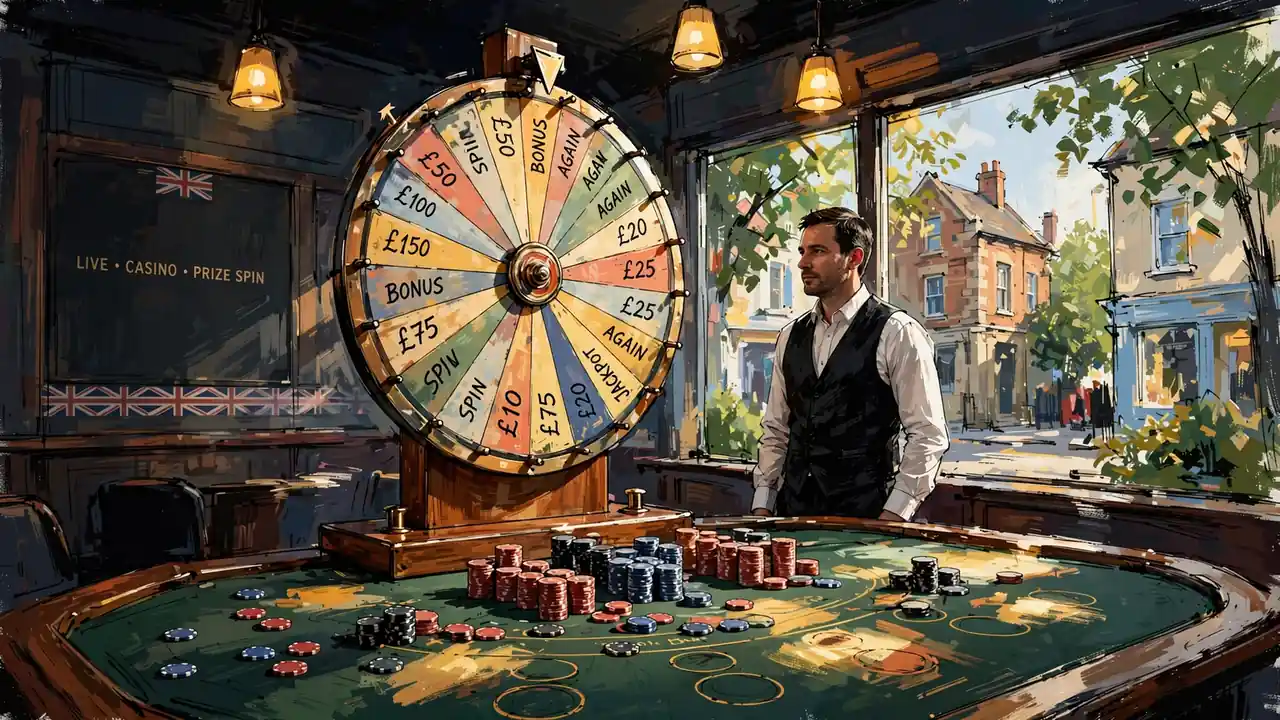
A practical guide to identifying the game, checking a live-casino listing and understanding what demos and reviews can establish.
Live Casino Games and the Evidence for Provider Claims
Live casino games combine gambling software with a streamed presentation of activity taking place at a table or studio. This distinguishes them from games in which every part of a round is presented through software alone, although the exact format varies by product. The category includes familiar casino games as well as formats designed around a different kind of entertainment. A live Dream Catcher online casino search therefore sits within a broader market: it concerns a named title, but also the larger question of how live-game products are described and identified.
The history of live casino provision in the UK offers a useful point of context. Grosvenor first introduced its live casino games in 2013, with card and casino games including Blackjack, Texas Hold’em and Roulette. That example establishes that live casino products have formed part of the operator’s offering for many years. It does not, by itself, establish anything about a particular title’s current availability, its software provider or its features. Historical context and product-specific evidence answer different questions.
That distinction matters because a casino game can be described through several related claims. A page may name a provider, identify a game, describe it as live, or imply that a particular operator makes it available. These are not interchangeable statements. Evidence that a company develops live products does not prove that every named game is made by that company. Evidence about a title does not establish that it is currently accessible through a particular casino. Each claim needs support suited to the claim being made.
Provider names can be useful identifiers, but they should not be treated as a guarantee of quality or as proof of a game’s exact presentation. A company’s portfolio may include products with different formats, and the label “live” alone does not explain how a given product works. The relevant evidence would need to connect the provider to the specific title and make clear what aspect of the product the claim concerns. A broad company description is weaker evidence than a direct, consistent identification of the game and its provider.
Live casino Lightning Roulette online in the UK
The same care applies to claims about the experience. Descriptions such as “interactive”, “real-time” or “studio-based” can communicate a general format, but they are not precise enough to establish particular functions. They should not be read as confirmation of features that have not been described clearly. Likewise, images and promotional language may illustrate a product’s appearance without demonstrating its operating details. In an evidence-led account, a claim should be no more specific than the material that supports it.
This approach is relevant to searches for Dream Catcher online casinos as well as to live casino games generally. The wording of a title or category can suggest that a product belongs to the live-casino space, but a suggestion is not the same as a documented product description. Reliable identification depends on consistency across the game’s name, provider attribution and the description of its format. Where those elements do not align, the discrepancy should remain unresolved rather than being filled by inference.
There is also a difference between a general statement about a provider and a statement about a particular casino. A provider’s association with live entertainment does not establish that every operator offers every product in its catalogue. Nor does the presence of a title in a broad discussion of live casino games confirm that the title can be played at a given time. These distinctions prevent general industry descriptions from being mistaken for evidence about an individual offering.
For a title such as Dream Catcher, the term “live” should therefore be understood as a product claim requiring clear identification, not as a complete account of how the game is presented. The wider live-casino category contains varied formats, and its familiar examples do not establish the properties of a different title. A sound description separates what is directly stated about the product from conclusions drawn merely from its category or from a provider’s wider reputation.
This evidential discipline is more useful than relying on confident wording. A claim about a provider should identify the relevant relationship; a claim about a game should refer to that game; and a claim about availability should concern the operator and the offering in question. Keeping those levels separate makes descriptions of live casino games more precise and reduces the risk of treating association, implication and confirmation as equivalent.
DO
- Identify the specific provider and game title
- Check the operator’s licence on the official register
- Read the specific game rules before playing
DON’T
- Assume a provider’s catalogue implies every game is available
- Use promotional language as evidence of quality
- Treat a mention of a game as proof of current availability
Dream Catcher in the Live-Casino Context
Dream Catcher is the specific subject of a live-casino search, not a general label for live games. That distinction matters because information about the wider category does not, by itself, confirm that a particular casino offers this title. A site may describe its live-casino range in broad terms while giving no clear indication that Dream Catcher is included.
The phrase “live” can also describe different things in casino material. It may refer to a game presented as part of a live-casino area, but the label alone does not identify the operator, the supplier, the game format or the terms attached to an offering. Those details need to be established separately. A page mentioning Dream Catcher alongside other live games is not necessarily evidence that the title can be opened or played there at the time the page is read.
The UK context adds a separate distinction. Gambling activity in the United Kingdom is regulated by the UK Gambling Commission, and remote gambling offered to consumers in Great Britain falls within its remit regardless of where the key equipment is located. Operators offering real-money gambling to customers in England, Scotland and Wales must hold the relevant Commission licence. The Gambling Act 2005 governs gambling in England, Wales and Scotland; it does not govern Northern Ireland. These points describe the regulatory framework, not the presence of any particular game in a casino’s catalogue.
Accordingly, a search for Dream Catcher at a UK-facing casino involves two different questions: whether the game is actually offered by the operator, and whether the operator is authorised to provide remote gambling to the relevant market. Neither answer can be inferred solely from the game’s name, a promotional image or a general live-casino page. The title and the casino are separate subjects, even when they appear together in a listing.
Online casino games for real cash in the UK
The wording used by operators may not be consistent. Dream Catcher could appear as a named entry, within a live-games category, or in promotional material that does not provide enough detail to identify the offering. A result that uses the same title may also refer to information about the game rather than an active casino product. This makes the distinction between an actual catalogue entry and a general mention important: a name on a page is evidence of a claim, but not conclusive proof that the game is available under current conditions.
The year in a search for a live Dream Catcher casino in the UK signals an interest in present-day availability. Casino catalogues and commercial terms can change, so an undated description cannot establish the current position. Even a page that once accurately described a game may remain accessible after the underlying offer has changed. Current status therefore depends on information that can be connected to the operator and checked at the time of use, rather than on wording that may have been copied across pages.
The same caution applies to the word “casino” in references to Dream Catcher. It may identify the setting in which the title is being discussed, but it does not establish that every casino carries it or that all listings refer to the same arrangement. Nor does a general description of live casino entertainment answer questions about the availability, access conditions or other terms of a particular title. Those are operator-specific matters.
This distinction keeps the subject narrow. General explanations of live casino games may provide context, but they cannot substitute for confirmation about Dream Catcher at a named operator. Conversely, a reference to Dream Catcher does not establish anything about the broader quality or completeness of a casino’s live catalogue. Each claim needs to be read according to what it actually says and whom it concerns.
UK Live Roulette and English-Speaking Dealers
The term “UK casino” also needs care. A website accessible from the United Kingdom is not, on that fact alone, shown to be authorised to offer gambling to consumers in Great Britain. The Commission is the regulator for commercial gambling in Great Britain and issues operating licences to businesses, as well as personal licences to individuals working in regulated roles. A game listing cannot establish an operator’s licence status; that is a distinct regulatory question.
Dream Catcher can therefore be understood here as a named live-casino offering whose availability is operator-specific, rather than as a feature that follows automatically from a casino’s use of live-game terminology. The relevant distinctions are between the title and the category, between a reference and an active offering, and between a game listing and the operator’s authority to serve the market. Keeping those claims separate avoids treating broad promotional language as proof of a particular current offer.
Assessing Casino Options Without an Unsupported Ranking
A claim that one casino is the best place to play Dream Catcher requires evidence that can be compared across operators. A prominent position in a search result, a polished promotional page or repeated use of the word “best” does not establish that conclusion. Without current, comparable information about access, terms and regulatory status, a ranked list would imply more certainty than the evidence supports.
The first distinction is between a casino that may carry the game and one for which current access has been confirmed. Availability can change, and a general description of a live-casino range does not necessarily confirm that Dream Catcher is available to a particular customer. A comparison should therefore separate direct, current information from assumptions based on an operator’s general branding or past coverage. Where access has not been confirmed, the appropriate conclusion is that the operator remains a possible option, not that it belongs in a definitive ranking.
Casino Dice Games in the UK: Rules and Context
Comparisons also need consistent criteria. If one casino is assessed by the apparent breadth of its live offering and another by promotional claims, the resulting order has little analytical meaning. A sound assessment would identify what is being compared, apply the same standards to each option and distinguish observable facts from interpretation. For instance, a statement about a game’s presence is different from an assessment of the clarity of its terms; neither, by itself, demonstrates that an operator is superior overall.
Promotional language should be treated as a claim to test, not as evidence in its own right. Descriptions such as “leading”, “exclusive” or “best” may be useful as a starting point for checking details, but they do not establish comparative quality. The same caution applies to claims of special access or favourable conditions: their meaning depends on the actual terms, including any relevant restrictions. If those terms are unclear or cannot be checked, the claim should not carry weight in a ranking.
A comparison should also make its limits visible. One operator might provide clearer information on a particular point, while another may not publish enough detail to assess it. That difference supports a conclusion about the available evidence, not necessarily about the underlying quality of the services. An absence of published information is not proof of poor performance, but it does leave a claim unverified. A careful account can say that evidence is insufficient rather than filling the gap with an assumed advantage.
Main Conclusions
- A game listing is a claim, not conclusive proof of availability or regulatory status
- Regulatory standing must be verified independently via the Gambling Commission register
- Comparisons between casinos should be based on consistent, verifiable criteria rather than promotional claims
For customers in Great Britain, regulatory status is a separate threshold from game availability or promotional appeal. Remote gambling operators serving the market are required to hold the relevant Gambling Commission licence, irrespective of where their equipment is located. A casino’s inclusion in a comparison should not be treated as confirmation that it meets this requirement; the licence number should be checked against the Commission’s public register before depositing. That check addresses regulatory status, not whether Dream Catcher is currently offered or whether the operator’s other claims are accurate.
The meaning of “best” also depends on the purpose of a comparison. A ranking intended to identify the clearest published terms would need different evidence from one purporting to assess game access or overall service. Without an explicitly defined purpose, a single ordered list can collapse distinct questions into a score that appears objective but cannot be reproduced. Any conclusion should state the criterion used and avoid implying that one dimension settles every other one.
For a UK audience, the most defensible answer to requests for the best Dream Catcher casinos is therefore not an unsupported league table. It is a comparison limited to claims that can be checked, with uncertainty stated plainly. Operators should not be described as current providers merely because a page mentions the game, and promotional rankings should not be repeated as established fact. Where reliable, like-for-like evidence is unavailable, no overall winner can responsibly be identified.
What a Dream Catcher Casino Listing Can Establish
A casino page that names Dream Catcher can be evidence that the operator has published information about the game. The strength of that evidence depends on what the page actually shows. A current, accessible game entry on an operator’s own site is more informative about its catalogue than a brief search-result description or a page copied from another source. Even then, the entry does not by itself establish that the game can be opened or played.
Online casino tournaments in the UK: rules and evidence
Search results can surface old pages, promotional material or references that no longer match an operator’s current offering. A title appearing in a snippet may come from text that has since changed, and a page may describe a product without providing access to it. The wording “live casino” also does not, on its own, verify that a listing leads to a live game. These distinctions matter when interpreting claims about casinos carrying Dream Catcher: a mention is not the same as confirmed, present availability.
The page’s origin is therefore relevant. An operator-controlled page can show what that operator says it offers, while an independent directory or affiliate page reports a third party’s claim. Neither type of listing should be treated as proof beyond what it directly displays. A page that identifies the game, names the operator and provides a functioning route to the offering gives a clearer basis for checking than an isolated name in a search result. Its details may still change, so the claim is tied to the page as it appears at the time it is inspected.
A listing also cannot establish an operator’s regulatory status. The Gambling Commission regulates remote gambling offered to consumers in Great Britain, and operators serving those consumers must hold the relevant licence. That status is a separate matter from whether Dream Catcher appears in a game catalogue. The Commission’s public register is the place to check an operator and its licence; a game page, search-result label or promotional description is not a substitute for that record.
Online European Roulette Casinos in the UK
The same separation applies to claims about the geographic audience of a page. A site may use UK-facing wording or present a game as available to British players, but the wording alone does not demonstrate that the operator is authorised to serve Great Britain. Conversely, a regulatory entry does not establish that a particular game is currently listed. Catalogue evidence and regulatory evidence answer different questions and should not be collapsed into a single conclusion.
A careful reading of a listing therefore identifies what is directly visible: who published it, whether the game is named, whether the page is accessible, and whether it provides a route to the offering. Broader claims require separate confirmation. No listing removes the need to check the operator’s licence before depositing, and gambling should be limited to what can be afforded to lose.
Playing the Dream Catcher Casino Game
Playing Dream Catcher at a live casino involves more than recognising the game’s name. The rules displayed for the specific offering determine what a round requires, what choices are available and how an outcome is settled. Those details should be read before any wager is placed; they cannot be inferred reliably from the title or from general descriptions of live casino games.
The game interface is the relevant place to establish how a particular version works. Its rules or help information should explain the sequence of play, the available wager options, any minimum or maximum stake, and how returns are calculated. If an explanation is unclear, the operator’s game information should be treated as more relevant than a third-party summary that may describe a different version or omit conditions. No assumptions about a wheel, numbers, symbols, multipliers or other mechanics should be made without confirmation in the game itself.
Mines Casino Game in the UK: What Evidence Shows
That distinction matters because “live casino” describes a setting, not a complete set of rules. A live presentation does not by itself show how a round begins or ends, whether participants make decisions during it, or how the result affects a wager. Nor does the word “game” establish whether its outcome is determined by chance, a participant’s choice, or a combination of factors. Such points are game-specific and require an explicit explanation from the offering being played.
A useful reading of the game screen separates three things: the stated rules, the controls used to place a wager, and the information shown after a round. The rules describe the conditions; the controls show which actions are available in that session; and the result display records what the operator has settled. If those elements appear inconsistent, the discrepancy should be resolved through the operator’s published rules or support channel rather than by relying on an informal description.
The same care applies to terminology. A displayed stake is the amount committed to a particular wager, while any stated return depends on the outcome and the rules governing that option. Descriptions of possible returns are not evidence that a particular result is likely. A sequence of previous outcomes, if shown, also does not establish what the next one will be. Past results should not be read as a prediction or as a reason to increase a stake.
Before You Play
- Check the operator’s licence on the Gambling Commission public register
- Read the specific rules and mechanics of the game version provided
- Confirm the operator’s legal name and domain match the register
- Set a personal financial limit for your session
Playing the Dream Catcher casino game therefore begins with identifying the rules that actually govern the selected offering, rather than importing details from another game or an unverified account. If the rules do not make the wager and its settlement clear, there is no sound basis for treating a description as a confirmed explanation of play. Any gambling should be limited to money that can be afforded to lose.
The Wheel and the Scope of Great Britain’s Slot Limits
A wheel-based presentation does not, by itself, show how a game is classified for stake-limit purposes. The relevant distinction is whether a game falls within the online slots category or is treated as roulette or blackjack. The image of a wheel, or the use of wheel-like features, is not enough to establish either classification for Dream Catcher.
A specialist casino review describes Great Britain’s online slot limits as £5 for each game cycle for adults aged 25 and over, and £2 for those aged 18 to 24. The same type of review says those limits do not cover roulette or blackjack. These statements should be read as claims made in that review, rather than as confirmation of Dream Catcher’s regulatory classification. They do not show that the game is a slot, roulette or blackjack, nor do they establish which stake rules apply to it.
This matters when interpreting a live Dream Catcher wheel. A wheel may be central to how a game looks, but appearance is not a reliable substitute for its formal category. Nor does the word “wheel” settle the question: it describes a visible feature, not necessarily the regulatory treatment of the game. Without a clear classification tied to the particular offering, it would be unsound to apply the slot limits to Dream Catcher merely because its presentation includes a wheel, or to assume that the roulette exclusion covers it.
The limits also concern stakes per game cycle, not a general ceiling on all gambling activity. That distinction prevents a further possible misunderstanding: a figure stated for online slots cannot automatically be treated as the maximum wager for every live casino game. The category of the game remains material.
For a casino listing or game screen, the useful question is therefore not simply whether a wheel is shown, but how the game is identified and what applicable rules are stated for that offering. A marketing label or visual resemblance may provide context, but it is not, on its own, proof of classification. Until that classification is clear, neither the slot limits nor the roulette and blackjack exclusion can safely be presented as Dream Catcher’s specific stake rule. The £5 and £2 figures describe the limits attributed to online slots in the specialist review; they should not be converted into a claim about the Dream Catcher wheel without a supported basis for doing so.
American Roulette Casinos in the UK: Licensing and Play
Checking a Live Dream Catcher Casino Site
A site presenting a live Dream Catcher game should be assessed separately from the game itself. A title, studio-style broadcast or “live casino” label does not establish that the business is authorised to provide remote gambling to people in Great Britain. The relevant check concerns the operator behind the site and its licence, not the appearance of the game page.
The UK Gambling Commission regulates online gambling and other commercial gambling activity in the United Kingdom. For remote gambling offered to consumers in Great Britain, its remit applies irrespective of where the operator’s key equipment is located. It is the sole regulator for commercial gambling in Great Britain. The Commission issues operating licences to businesses; personal licences relate to individuals working in relevant operating roles. These are different forms of authorisation and should not be treated as interchangeable.
Before depositing, locate the operator’s legal name and check it, together with the relevant licence number, against the Commission’s public register. Compare the register entry with the business named in the site’s terms and conditions, and check that the site’s domain is associated with the licensed operator. A familiar brand, a licence badge or a claim in promotional material is not a substitute for matching the business and domain to the register. If the details do not correspond, the site’s own statement does not resolve the discrepancy.
The check also needs to concern the operator that would hold the account and receive the deposit, rather than an unrelated company mentioned on the page. Where ownership, domain or licence details are unclear, the regulatory position has not been established by the site’s presentation alone. A game listing can indicate that Dream Catcher is advertised, but it cannot confirm that the operator is authorised to offer it to Great Britain customers.
Regulatory status does not establish that a particular game is currently available, nor does it verify the terms attached to that game. Those are separate claims requiring separate evidence. The register check has a narrower purpose: confirming whether the business offering remote gambling to Great Britain consumers appears under the appropriate Commission authorisation.
What a Dream Catcher Demo Can and Cannot Show
A Dream Catcher demo may sound like a way to inspect the game before choosing a live casino, but the label alone does not establish what is being offered. A page using the word “demo” could describe a playable simulation, a preview or merely an informational page. Its contents need to be examined before conclusions are drawn about what it demonstrates.
Even if a playable demonstration is available, it would show only the experience provided in that demonstration. It would not, by itself, confirm that Dream Catcher is currently available for real-money play at a particular casino. Nor would it establish the operator’s terms, the game’s current configuration or whether the demonstration corresponds to the version offered at a live table. Those are separate claims requiring evidence from the relevant operator or other reliable records.
The distinction matters because “live casino demo” can imply a connection to a real-time table, while a demonstration may not provide one. Without clear information about how it operates, the term should not be treated as proof of a live feed, real participants or the same conditions as paid play. A visual resemblance to a casino interface is not sufficient evidence of those features.
A careful assessment therefore separates three questions: whether a demo can be accessed, what it actually displays, and whether a real-money Dream Catcher game is offered by the casino concerned. Evidence for one does not answer the others. Descriptions should be checked against the page itself, and claims about availability or terms should be corroborated with the operator rather than inferred from a promotional label.
A demonstration also cannot establish regulatory status. That question concerns the operator and its authorisation, not the appearance or availability of a game preview. A demo should not be treated as a substitute for checking the relevant licensing information before depositing.
Does a demo confirm real-money availability?
No, a demonstration may be a simulation or preview and does not guarantee the game is currently available for real-money play at that casino.
Can I use slot limits for Dream Catcher?
Not necessarily; the classification of a game as a slot, roulette, or blackjack determines which stake rules apply, and visual features like a wheel do not settle this.
How can I verify an operator’s legitimacy?
Locate the operator’s legal name and licence number, then check them against the UK Gambling Commission’s public register.
Where no accessible demonstration or precise description can be confirmed, the content of a purported demo remains uncertain. That uncertainty should not be filled by assuming that a preview exists or that it reproduces real-money play. Any subsequent gambling should be limited to money that can be afforded to lose.
How to Read a Dream Catcher Casino Review
A review of a casino’s Dream Catcher offering can combine several different claims: that the game is available, that it is live rather than a demonstration, and that particular conditions apply to play. These claims need not have the same evidential basis. A confident overall rating does not, by itself, show how each point was checked.
The most useful reviews make their scope clear. They distinguish observations made within a named casino account from information copied from a provider description or another publication. They also explain when the assessment was conducted. Availability and terms can change, so an undated statement may describe a past position rather than the current one.
Specificity matters, but detail is not proof. A screenshot may show a game tile or interface at a particular moment; it does not necessarily establish that the game remains accessible, that the image came from the named operator, or that the same conditions apply to every account. Likewise, repeating an operator’s promotional wording is not independent confirmation of the claim.
Ratings should be read as judgements, not as verified facts. A numerical score may reflect a reviewer’s chosen criteria, and a high score cannot establish that Dream Catcher is available or suitable for every player. Greater weight belongs to claims that are clearly attributed, supported by relevant evidence and limited to what that evidence can show.
A careful reading therefore separates the review’s factual statements from its opinions. It asks whether the text identifies what was examined, whether its evidence supports the particular claim, and whether it acknowledges uncertainty where circumstances may have changed. If those distinctions are absent, the review may still offer an impression, but it should not be treated as confirmation of the casino’s current offering.
Crazy Time Live Casino Game Show in the UK
Review quality is also separate from regulatory status. A favourable account of the live experience does not establish that an operator is authorised to serve customers in Great Britain; that question requires a separate check of the relevant official record. Reviews can inform an assessment, but they cannot replace independent verification. Gambling should be limited to what can be afforded to lose.
Playing Live: Practical and Account-Safety Considerations
Playing a live casino game involves more than deciding whether a particular title is available. Before opening a real-money account, the operator’s identity and Gambling Commission licence should be checked on the Commission’s public register. The register can establish licensing details; a game page or promotional description cannot substitute for that check.
Age verification is required before an operator allows a customer to deposit. Remote gambling operators must also prompt new customers to set a financial limit before their first deposit and make account-level limit controls accessible. These safeguards are relevant whether the game is Dream Catcher or another live title. A limit should reflect a considered budget, and gambling should be confined to money that can be afforded to lose.
Self-exclusion is another account-safety measure that UK-licensed casinos must provide. GAMSTOP is the national self-exclusion programme for online gambling with participating operators. Its availability does not change the need to consider whether gambling is manageable; support is also available through services such as GamCare, BeGambleAware and Gamblers Anonymous.
If a dispute arises, a UKGC-licensed operator must provide an internal complaints process and access to an approved Alternative Dispute Resolution service. Keeping account correspondence and relevant transaction records can help make a complaint clear, though it does not determine its outcome.
These protections concern the account and operator, not the specific rules or availability of Dream Catcher. A live presentation should not be treated as evidence that play is risk-free or suitable for every person. Where gambling causes concern, self-exclusion and independent support may be more appropriate than continued play.
What are the online slot stake limits in Great Britain?
The maximum stake is £5 per game cycle for adults aged 25 and over, and £2 for adults aged 18 to 24. These limits do not apply to roulette or blackjack.
Are online casino games licensed and regulated?
The UK Gambling Commission regulates remote gambling offered to consumers in Great Britain. Operators serving those consumers must hold the relevant licence.
Is LuckyPays licensed by the UK Gambling Commission?
No entry for LuckyPays under that brand or its stated domain, including luckypays.io, appears in the public Gambling Commission register dated 26 September 2026.