

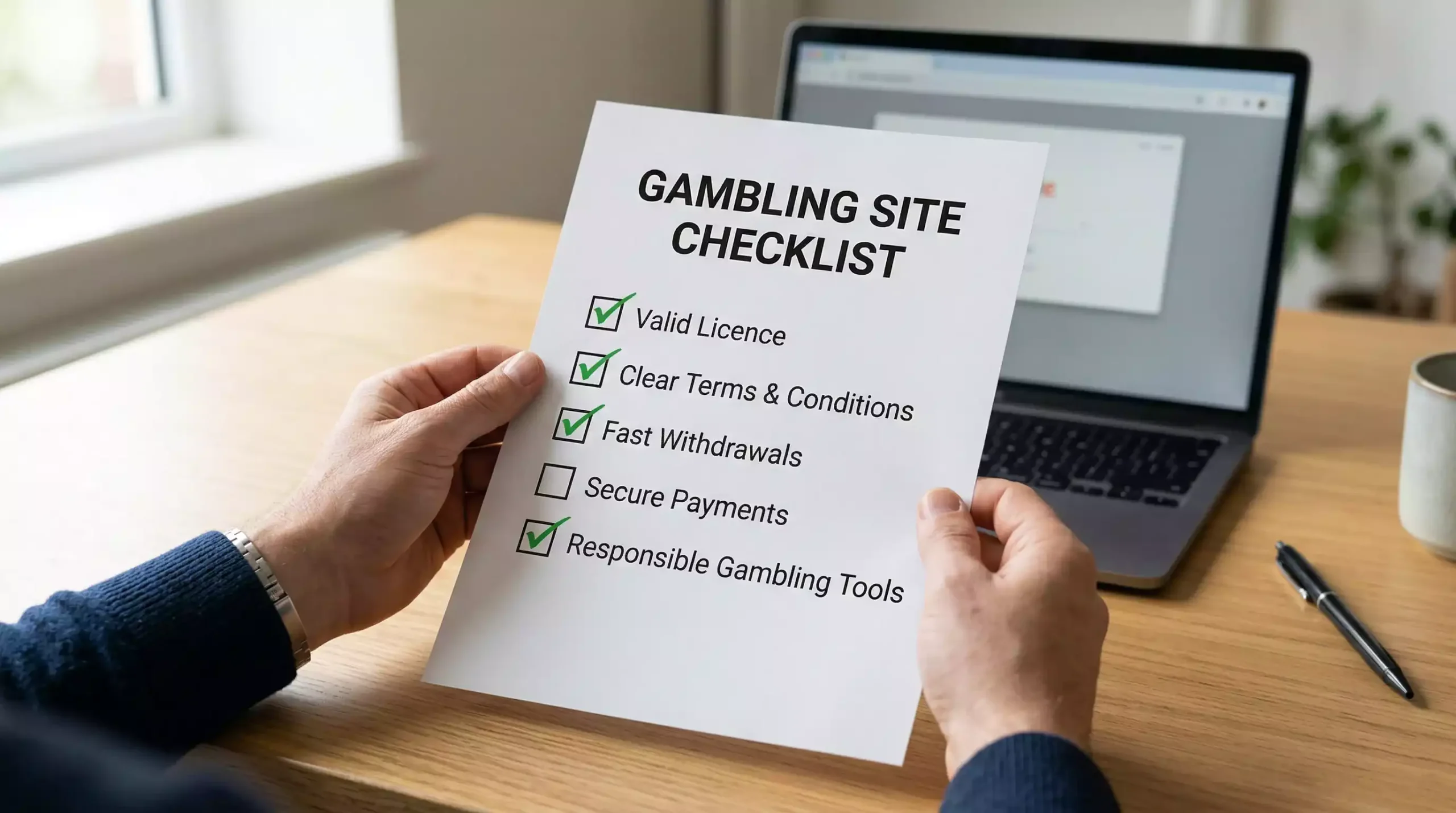
A Checklist, Not a Guess — How to Pick the Right Site
Choosing a gambling site shouldn’t be based on an advert. It shouldn’t be based on a friend’s recommendation without context, a social media post with an affiliate link, or the fact that a particular brand sponsors your football club’s shirt. These are all inputs, and some of them might point in useful directions, but none of them constitutes a method. A method is a structured way of evaluating something that reduces the chance of ending up somewhere you’ll regret — and in a market with over two hundred UKGC-licensed operators, the need for a structured approach is not optional.
The framework that follows isn’t complicated. It covers seven evaluation points, each of which addresses a specific dimension of the gambling experience: licensing and safety, game selection, bonus terms, payment methods, customer support, mobile experience, and responsible gambling tools. No single point is sufficient on its own. A site can hold a valid licence and still have predatory bonus terms. It can offer four thousand games and still process withdrawals at a glacial pace. It can have an excellent mobile app and still bury its responsible gambling tools three menu levels deep. The value of a checklist is that it forces you to look at the whole picture rather than being dazzled by whichever aspect the operator chooses to advertise.
Working through these points for any site you’re considering takes roughly an hour. That sounds like effort, and it is — but it’s a one-time investment per site. Once you’ve verified the licence, tested the interface, read the bonus terms, and confirmed the withdrawal timeline, you have a baseline that remains valid until the operator changes something material. An hour of evaluation up front prevents weeks of frustration down the line, and the information required to complete each check is publicly available on the operator’s own site or through the UKGC register.
The order matters. Start with licensing — because nothing else on the checklist matters if the site doesn’t hold a valid UKGC licence — and end with responsible gambling tools, which should be the final confirmation that the operator takes its obligations seriously rather than treating them as a regulatory afterthought.
Check the Licence Before Anything Else
No UKGC licence, no consideration. This is the non-negotiable first step, and it takes less than a minute. Scroll to the footer of any gambling site and look for a licence number — it’s usually displayed alongside the Gambling Commission logo. The format is a six-digit number. Copy that number and enter it into the UKGC public register. If the licence is active and the registered company matches the site you’re evaluating, the site is operating legally within the UK regulatory framework. If the number is missing, doesn’t match, or returns no result, close the tab.
What a UKGC licence guarantees is substantial. It means the operator’s games have been independently tested for fairness, that customer funds are held in segregated or trust accounts, that the site is subject to anti-money laundering compliance, that an approved alternative dispute resolution provider is available if things go wrong, and that the operator must comply with the Licence Conditions and Codes of Practice — a comprehensive set of rules covering everything from advertising standards to responsible gambling provisions. It does not guarantee that the site is good, that the bonuses are fair, or that you’ll enjoy playing there. It guarantees that you’re operating within a framework that gives you recourse if you need it.
Red flags at this stage are definitive. A site that displays a licence from Curaçao, Anjouan, or another non-UK jurisdiction while targeting UK players is operating outside the UKGC framework. These sites are not illegal for UK residents to visit, but they are unregulated in the UK, which means none of the protections described above apply. A site that displays no licence information at all is the clearest warning sign available. No legitimate UK gambling operator omits this information — it’s a licence condition to display it.
Match Features to How You Gamble
A slots player and a sports bettor need completely different platforms. This seems obvious stated plainly, but the majority of gambling site comparison content treats all players as if they have the same requirements — a universal “best site” that serves everyone equally well. That site doesn’t exist. A platform optimised for sports betting has deep market coverage, competitive odds margins, in-play tools, and bet builders. A platform optimised for casino play has a large game library from diverse providers, high-RTP titles prominently featured, and a strong live casino offering. Overlap exists, but the priorities are different, and choosing a site that excels in your primary area of interest will produce a meaningfully better experience than choosing one that’s average across everything.
If your primary interest is slots, evaluate the game library by provider count and RTP transparency. A site listing games from twenty-plus providers — including studios like NetEnt, Pragmatic Play, Play’n GO, and Big Time Gaming — offers the variety you need to find titles that match your preferences. Check whether the site displays individual game RTPs in the lobby or within the game info screen. Sites that publish this data openly are more likely to stock high-RTP titles, while sites that bury or omit the information may be curating toward lower-return games that generate more revenue.
If you’re a sports bettor, odds margins matter more than anything else on this list. A bookmaker running 2–3% margins on major football leagues gives you measurably better value than one running 5–6%. Check whether the site offers bet builders across multiple sports, in-play markets with real-time odds updates, and cash-out functionality that works reliably. Live streaming is a bonus but not essential — a fast, accurate odds feed matters more when you’re betting in-play than whether you can watch the match through the same app.
For live casino players, the provider determines the experience. Evolution Gaming dominates the UK market, but Playtech Live and Pragmatic Play Live offer competitive alternatives with different table styles and betting limits. Check the number of live tables available during peak hours, whether VIP tables with higher limits are offered, and whether game show titles are included in the lobby. Mobile performance for live casino is particularly important — stream quality and latency vary between sites, and a choppy feed during a live blackjack hand is more than an inconvenience.
Whichever category you fall into, test the mobile experience before you commit. Load the site on your phone, navigate the lobby, try a demo game if available, and check how many clicks it takes to reach the deposit limit settings. The mobile interface is where you’ll spend the majority of your time, and a site that’s awkward to use on a phone screen is one you’ll either tolerate with frustration or abandon within a week.
Read the Fine Print — Bonuses, Limits, and Fees
Terms and conditions are where the surprises live. The welcome bonus headline — “100% match up to £100” — is the shop window. The terms attached to it are the contract. The gap between the two can be anything from minor to disqualifying, and you won’t know which until you read the full conditions. Since the UKGC’s 10x wagering cap took effect on 19 January 2026, the worst excesses of bonus terms have been curtailed, but operators have adapted by adjusting other parameters. Maximum withdrawal caps, game contribution rates, minimum deposit thresholds, and expiry windows all vary across sites and all affect the real value of what’s being offered.
Beyond bonuses, check the withdrawal policy. What’s the minimum withdrawal amount? Is there a maximum daily, weekly, or monthly cashout limit? Does the site impose a pending period during which you can reverse a withdrawal request? Pending periods are one of the more problematic practices still present in the UK market — they exist to encourage players to cancel withdrawals and continue playing, and any site that imposes one longer than twenty-four hours should be treated with scepticism.
Inactivity fees are another item buried in the terms that catches players off guard. Some operators charge a monthly fee — typically £5 to £10 — on accounts that have been dormant for a specified period, usually six to twelve months. The fee is deducted from any remaining balance until the funds are exhausted. It’s legal under UKGC rules provided the terms are disclosed, but it’s a practice that penalises players for not gambling, which is an uncomfortable incentive structure. If you plan to maintain accounts at multiple sites and don’t intend to use all of them regularly, check the inactivity policy before depositing.
Maximum payout policies are the final overlooked term. Some sites cap the maximum amount you can win from a single bet or bonus at a level that could affect significant wins. A £250,000 cap on jackpot slots is standard and unlikely to affect most players. A £5,000 cap on bonus winnings is much more relevant and can mean that a large win during wagering is truncated before you ever see it. These limits are always disclosed in the terms. They are rarely disclosed on the page where the bonus is advertised.
One Hour of Research Saves Months of Frustration
Spend time choosing — not time regretting. The seven-point framework described above — licensing, game selection, bonus terms, payment methods, customer support, mobile experience, responsible gambling tools — is not exhaustive. There are secondary factors that matter to individual players: specific game availability, loyalty programme structure, the quality of the help centre, whether the site supports your preferred currency or language. But the seven points cover the foundations. A site that passes all seven is almost certainly a competent, well-run platform. A site that fails on any one of them has a structural weakness that will affect your experience sooner or later.
The research process is front-loaded by design. Once you’ve evaluated a site and decided to register, the ongoing maintenance is minimal: check the terms of any new bonus before claiming it, verify withdrawal timelines periodically, and keep your responsible gambling settings active. The heavy lifting happens before your first deposit, not after it. Players who skip this step and register impulsively tend to discover the problems the hard way — through a withdrawal delay, a bonus surprise, or a customer support experience that reveals the gap between the marketing and the reality.
The UK gambling market is well regulated, and the average UKGC-licensed operator is competent. But “average” covers a wide range, and the difference between the best operators and the merely adequate ones shows up in exactly the areas this checklist examines. An hour spent evaluating is an hour invested in making the experience that follows — potentially months or years of play — safer, more transparent, and more enjoyable. That’s a return worth claiming.
Find top-rated sites at top10gamblingsites-uk. Also see our best gambling sites UK.