

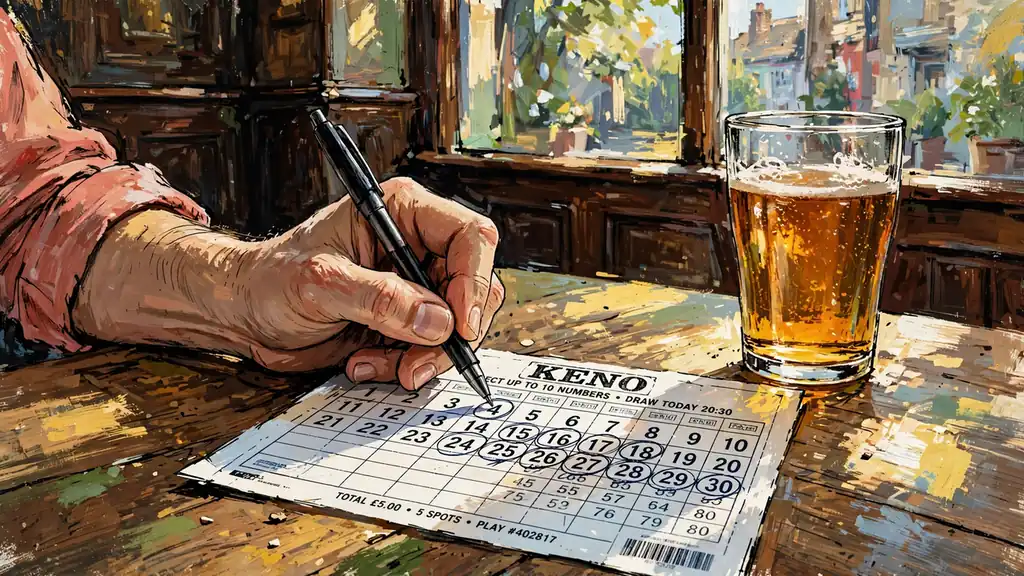
Keno outcomes compare selected numbers with a draw, while stakes and matches shape any payout.
How Keno Draws and Number Selection Work
Keno is built around a comparison between numbers selected for a game and numbers appearing in a draw. The selected numbers form the player’s entry; the draw supplies the result against which that entry is assessed. A payout, if one is due under the game’s rules, depends on the stake and on how many selected numbers appear in the draw.
This relationship is the central mechanic across online versions of the game. The interface may present the process differently, but the underlying question remains whether the draw contains some or all of the numbers chosen. The number of matches matters: a result is not assessed simply by whether the entry contains a particular favourite number. The stake also matters because payout calculations take both the stake and the number of matches into account.
The distinction between a selection and a draw is important. A selection is made before the result is known; it does not influence the numbers that appear. Nor does the draw adjust itself to favour or avoid the chosen numbers. The outcome is assessed after the draw, by comparing the two sets of numbers.
Independent draws
Each keno draw is independent of earlier draws. A previous result therefore does not make a number more or less likely to appear in the next one. A number that has appeared repeatedly is not, on that basis, due to disappear; a number absent from recent results is not thereby due to return.
This is a statement about the relationship between draws, not a prediction of any particular result. Independence does not mean that a particular selection will match, nor does it ensure that results will look evenly distributed over a short sequence. A run of similar outcomes can occur without changing the status of the next draw. Past results may be recorded for reference, but they do not provide a mechanical advantage in a later independent draw.
The same point applies when a game is accessed online. A history panel, if present, can show earlier outcomes, but viewing that history does not make those outcomes predictive. Patterns noticed in a limited record may be descriptive of what has already happened; they do not alter the draw that follows.
Bonus Buy Slots in the UK: How the Feature Works
What a match means
The number of selected numbers that appear in a draw provides the basis for assessing an entry. More matches can affect the payout, but the result must be interpreted under the rules of the particular game. The general mechanic alone does not establish a universal payout table or show that every possible match produces a return. Those details are specific to the game’s stated rules.
A keno casino game should therefore be understood as a selection-and-comparison format rather than as a sequence in which one result carries over into the next. The chosen numbers define what will be compared; the draw determines which of them appear; and the stake and match count are relevant to the payout. These elements are connected, but none makes previous draws a guide to future outcomes.
This also helps distinguish the game’s basic logic from the way it is displayed. An online version may use a visual board or another interface to show selections and results. Such presentation does not, by itself, change the underlying relationship between the selected numbers and the draw. Where a particular version adds rules or features, its own explanation is needed to establish what those features do.
Free play and demonstrations
A free-play or demo version, where offered, can illustrate how selections are compared with a draw. The same conceptual distinction remains: the entry is set apart from the result, and matches are assessed after the draw. A demonstration can help make that sequence intelligible, but it should not be treated as evidence that earlier outcomes predict later ones. Independence applies to the draw mechanic, not to a player’s interpretation of a history.
The available mechanics also do not establish that all online keno games use identical interfaces, selection options or payout schedules. Those details should not be inferred from the word “keno” alone. The stable point is narrower: payouts depend on the stake and the number of selected numbers appearing in the draw, while one draw does not influence another. That is the basis for understanding how number selection works without mistaking past results for a forecast.
Keno is a selection-and-comparison format where the outcome is determined by the number of matches between the player’s entry and the draw.
Keno Casinos in the UK: Licensing and Verification
Keno is a casino game, so its presence on a website does not by itself establish that the site may lawfully offer it in Great Britain. The relevant distinction is whether the gambling operation serving British customers is covered by the UK Gambling Commission’s licensing framework. A site may display keno and describe itself as regulated, but those statements are not a substitute for confirming its status.
A casino operating legally in Great Britain must either hold the appropriate remote gambling licence or provide its service through a white-label arrangement with a business that holds the relevant licence. In the latter case, the consumer-facing brand and the licence holder may not be the same entity. That makes it important to establish which licensed business is responsible for the gambling service, rather than relying only on the name or appearance of the website.
The UK Gambling Commission regulates keno when it is offered by a licensed operator to consumers in Great Britain. The location of the operator’s equipment does not remove the activity from that regulatory framework. In practical terms, a business cannot avoid the British licensing requirement simply by hosting its website or technical systems elsewhere. A claim that a casino is supervised by a regulator in another jurisdiction also does not establish that it is authorised to serve British customers.
What a licence check establishes
The Commission’s public register is the reference point for checking whether the relevant business holds a licence. A site’s own statements, badges, or references to regulation should be treated as claims to verify, not as proof in themselves. The website should provide licence information and a link to the operator’s public-register details; the information can then be compared with the register entry.
UK Online Casino Payout Speed: What the Evidence Shows
For a brand using a white-label arrangement, the check must account for the licence-holding business behind the service. A brand name may not appear as the licensed entity, so the relationship should be identifiable from the site’s licensing information and consistent with the register. If the responsible operator cannot be established, or the details shown on the site do not correspond with the public record, the site’s legal status has not been confirmed.
The check concerns the entity and service actually offered, not just whether a familiar company name appears somewhere in a search result. A licence held by an unrelated business would not demonstrate that a particular keno casino is covered. Equally, a general statement that a group operates licensed brands does not, on its own, show that the specific website or arrangement serving customers is within the relevant licensing framework.
Why other regulatory claims are not enough
Some gambling sites refer to an overseas licence or another form of international oversight. Such information may describe the operator’s position elsewhere, but it does not replace the licence required for offering gambling to people in Great Britain. If a keno site accepts British customers without the necessary UK Gambling Commission licence or a qualifying white-label arrangement with a licence holder, its offer is illegal in Great Britain, irrespective of regulatory claims made about another country.
This distinction matters because “regulated” is not a universal status. A business may be subject to rules in one jurisdiction without being authorised to provide the same service in another. For British consumers, the relevant question is whether the gambling operation is covered by the Commission’s requirements for Great Britain, not whether the site can point to some form of external supervision.
Licensing Check
Do not rely on a website’s own claims or logos; verify the operator’s status directly via the UK Gambling Commission’s public register.
Assessing a site’s status
A sound assessment therefore begins with the operator responsible for the keno service, then checks that entity against the Commission’s register and considers whether the website’s own licensing details align with the register. Where a white-label structure is involved, the licensed partner must be identifiable; the brand alone may not tell the full story. A promotional claim or regulator logo should not be treated as sufficient evidence without this comparison.
This is a test of legal status, not a ranking of keno casino sites. Licensing can establish whether an operator is authorised to provide gambling in Great Britain, but it does not determine whether a particular site offers the best experience or suits an individual’s preferences. Those are separate questions. For the narrower issue of legitimacy, the essential distinction remains whether the site’s service is provided under the required UK Gambling Commission licence, directly or through a valid licensed arrangement.
Assessing Keno Casino Sites Without a Ranked List
A “top” label does not, by itself, establish that one keno casino is better than another. A defensible comparison needs consistent, checkable criteria and evidence tied to the particular operator and product. Without those, rankings may reflect how a page presents its choices rather than a demonstrated difference in service or game quality.
The distinction matters because a casino’s general reputation does not establish that it offers keno, and a keno listing does not establish the terms or features of the game. Claims about an app, a mobile version or access through a cryptocurrency-funded account also need to be assessed separately. A site name appearing beside these descriptions is not sufficient evidence that each feature is currently available or operates as described.
A careful assessment would separate several questions:
- Is there evidence that the site offers keno, rather than casino games generally?
- Does the claim refer to a dedicated app, a mobile website or another form of access?
- Are statements about the game’s return or other performance measures tied to a specific keno product?
- Can the operator’s identity and regulatory status be checked independently?
These are not interchangeable measures. An app claim concerns access; it says nothing on its own about the game’s terms. A return-to-player figure, if published, needs to be connected to the relevant game and presented with enough context to interpret it. A broad casino ranking cannot fill those gaps.
LuckyPays illustrates why dated, specific checks matter. A specialist review reports that the UK Gambling Commission register dated 26 September 2026 contains no entry under the LuckyPays brand or the stated domain, including luckypays.io. This describes what that register showed on that date; it is not a permanent finding about every later entry or a substitute for checking the register again. The observation should also be kept distinct from claims about the operator’s keno catalogue, app availability or game performance, which it does not establish.
Likewise, an operator’s own descriptions can document what it claims to offer, but they do not independently confirm the claim. A comparison becomes more useful when each statement is attributed and can be checked against an appropriate record or product information. Where that connection is absent, the claim should remain a claim rather than being turned into a ranking criterion.
Searches for an online casino with keno may therefore lead to pages that differ in what they actually substantiate. Some may discuss a casino brand without identifying a particular keno game; others may use “best” or “top” without explaining the basis for that judgement. Those labels should not be treated as evidence of verified superiority.
The same restraint applies to listings of keno casino apps and crypto or bitcoin casinos. Naming a platform category does not establish that a particular operator provides it, nor does it establish the conditions attached to its use. Without product-specific confirmation, such descriptions cannot support a reliable comparison.
A ranked shortlist would imply that the named sites had been assessed on comparable, verified grounds. Where that standard is not met, an unranked account of what can be checked is more accurate than a numbered order presented as a finding.
Keno Casinos in the UK: What the Evidence Establishes
Keno offered through an online casino is part of the wider remote-gambling market when it is made available to consumers in Great Britain. The relevant regulatory question is therefore not whether a site uses “keno” in its name, but whether it offers gambling remotely to people in this market. Operators doing so are required to hold the appropriate licence from the UK Gambling Commission.
That requirement applies to the operator rather than to a particular game label. A site may present keno alongside other casino games, but the format of its games does not remove the licensing obligation. Nor does the operator’s physical location determine whether the rule applies: the obligation concerns remote gambling offered to consumers in Great Britain.
French Roulette Online Casinos in the UK: Rules
This provides a useful boundary for interpreting references to a UK keno casino. The phrase may describe a site accessible from Britain, but accessibility alone does not establish that its operation is authorised for this market. A licence from an authority elsewhere is not a substitute for the relevant Gambling Commission licence when an operator serves consumers in Great Britain.
The same distinction applies when keno is associated with digital currencies. A reference to bitcoin, or another payment method, does not by itself establish that a casino is licensed to offer gambling in Great Britain. The regulatory status follows from the operator’s activity and the market it serves, not from the currency mentioned in a description. Whether a particular site accepts a given payment method is a separate matter from whether it holds the required licence.
The word “UK” can also be broader than the precise jurisdiction addressed by the remote-operator requirement. Great Britain comprises England, Scotland and Wales; Northern Ireland has a separate legal framework. For a claim about remote gambling serving consumers in Great Britain, the relevant licensing standard is the Gambling Commission’s. A general description of a casino as British or UK-facing should not be treated as proof of its regulatory status.
These distinctions limit what can be concluded from broad claims about the best online keno casinos in the UK. A ranking or promotional description does not establish that the named operators meet the licensing requirement, and a game’s presence on a website does not do so either. The meaningful jurisdictional point is narrower: remote operators offering gambling to consumers in Great Britain must hold the relevant Gambling Commission licence. Whether an individual casino satisfies that condition is a separate, operator-specific question.
Regulatory Requirement
Remote operators offering gambling to consumers in Great Britain must hold a relevant UK Gambling Commission licence.
Keno’s place in the market can therefore be described without treating it as a separate regulatory category. Its online availability falls within the framework for remote gambling when offered to consumers in Great Britain. The name of the game, the site’s branding, and references to a particular currency do not replace that jurisdictional test.
Playing Keno Online: Stakes, Selections and Results
A keno round can be understood through three linked elements: the stake placed on the game, the numbers selected for that round and the numbers that appear in the draw. The result is assessed by comparing the selection with the draw. The number of selected numbers that appear, together with the stake, determines the payout.
The selection is therefore central to the result, but it is not the payout by itself. Two rounds with the same number of matches can produce different payouts if their stakes differ. Conversely, the same stake does not guarantee the same return: the number of selected numbers found in the draw also matters. A payout is tied to both parts of that calculation, rather than to a match count considered in isolation.
Fast Payout Online Casinos in the UK: Evidence Explained
Following a round from selection to result
The sequence is straightforward at a high level. A player makes a selection and sets a stake before the draw. Once the draw has produced its result, the selected numbers are compared with those drawn. The resulting match count is then used with the stake to establish the payout.
This distinction helps when interpreting a displayed result. A match count describes how the selection compared with the draw; it does not, on its own, state the amount returned. The stake must also be taken into account. Nor does the stake alone explain the result, since the comparison between selected and drawn numbers remains part of the calculation.
For example, consider two hypothetical rounds with different stakes but the same match count. Their payouts need not be identical because the stake differs. If the stakes are the same but the match counts differ, the payouts may also differ. The precise amount cannot be inferred from either detail alone without the applicable payout calculation.
What “playing” describes
Playing keno online refers to taking part in this selection-and-draw process through an online casino. The phrase “keno slots” may also appear in descriptions of online games, but the label does not change the basic relationship between stake, selection and result described here. A slot-style presentation should not be taken as evidence that the payout is determined solely by a reel display or by the stake.
The same distinction applies when considering how to play keno at a casino: the essential result is the comparison between the chosen numbers and those appearing in the draw, with the stake affecting the payout. Interface details may vary, but the underlying relationship does not require a particular screen layout to be understood.
A clear way to read a result is to separate its components: what was selected, how many selected numbers appeared, and what stake was attached to the round. Keeping those elements distinct prevents a match count from being mistaken for a payout figure. It also avoids treating a stake as a prediction of what a round will return.
House Edge
The theoretical share of stakes an operator is expected to retain over time.
The practical summary is simple: the selection defines what can match, the draw establishes the outcome, and the stake contributes to the payout calculation. Keno payouts depend on the stake and on how many selected numbers appear.
Keno Slots, Free Play and Return-to-Player Claims
Keno may be presented in a slot-style interface, but that format does not make every keno game a slot or give it a single standard return-to-player percentage. The interface describes how the game is displayed; payout terms depend on the game’s own rules, including the stake and how many selected numbers appear in the draw.
RTP is a theoretical measure of the share of stakes a game is designed to return over extensive play. It is not a forecast of what an individual session will return, nor a promise of a particular result. A house edge describes the corresponding theoretical advantage retained by the operator. These measures can help describe a game’s structure, but they should not be treated as interchangeable with a guaranteed outcome.
Low-Volatility Slots UK: How Returns Are Distributed
A specialist review has reported online keno house edges ranging from approximately 5% to 25%, with the figure dependent on the number of spots selected and the casino. This is a reported range from that kind of review, not a settled benchmark for every keno game or operator. It also does not establish an RTP for a particular title. A comparison is meaningful only when the game rules and the basis of the calculation are clear.
Free-play versions are relevant to people who want to see how a keno interface presents selections and results without treating the session as a real-money game. The label alone does not establish that a free version uses the same rules, payout table or software configuration as a corresponding paid game. Any comparison between free and paid play therefore depends on the details displayed for each version. A free-play result, in itself, does not establish the return that would apply to a paid game.
The phrase “keno strategy” can refer to choosing a number of spots, selecting particular numbers, or interpreting previous results. None of those approaches makes earlier draws affect later ones: each draw is independent. A past sequence therefore cannot be used to infer that a number is due, and a preferred selection does not establish a higher chance of a particular payout. The relevant comparison is between the selection and the game’s stated payout rules, not between a selection and a supposed pattern in earlier results.
Software is another source of possible confusion. A casino interface, a game title and the software supplying a game are distinct aspects of an online product. Identifying one does not, by itself, establish the game’s RTP or the terms governing its payouts. Those details require game-specific information rather than assumptions based on visual style or the word “slot”.
Accordingly, broad claims about an average keno RTP should be read cautiously. A figure may refer to a particular title, spot selection, payout table or operator rather than to keno as a whole. Without comparable game-specific terms, a single average would obscure the variation described in specialist reviews. Free play can show how a version is presented; it cannot, on its own, substantiate a real-money return claim.
Attention A free-play version does not establish the return or rules that would apply to a real-money game.
Playing Keno for Real Money: Risk and Account Conditions
Real-money keno involves a financial risk that cannot be judged from the game’s format alone. The house edge—the share of stakes a game is expected to retain over time—can vary with the number of spots selected and the casino. A specialist review reports a range of approximately 5% to 25% for online keno; this is a source-specific estimate, not a fixed figure applying to every game or operator. It indicates why a single house-edge assumption should not be carried across different keno offerings.
A lower stated edge, where one is available, would not remove the possibility of losing a stake. Nor does a favourable result in one session establish what will happen in another. Real-money play should therefore be understood as gambling, rather than as a predictable way to recover previous losses or produce a return.
In Great Britain, keno provided by a licensed operator is within the UK Gambling Commission’s regulatory framework. Remote operators serving consumers in Great Britain must hold the relevant Commission licence; a licence issued elsewhere does not replace that requirement. The rules apply to the operator’s provision of gambling to British consumers, regardless of where its key equipment is located.
Account controls also shape the conditions under which real-money play can take place. Operators must verify a customer’s age before allowing deposits. For new customers, they must prompt a financial limit to be set before the first deposit and make account-level limit controls accessible. UK-licensed casinos must also provide responsible-gambling tools, including self-exclusion.
Live Baccarat Online Casinos in the UK: Key Checks
Payment and dispute arrangements are relevant to the account, although they do not change the keno game’s underlying risk. UK-licensed casinos cannot accept credit cards for gambling, including credit-card funds routed through a money-service business or through a wallet that permits such funding. A licensed operator must provide an internal complaints process and access to an approved alternative dispute resolution service.
These safeguards do not make an individual session profitable or eliminate the house edge. They establish regulatory and account conditions around play, while the financial outcome remains dependent on the game’s rules, the stake and the result. Free-play access, where offered, does not by itself establish the terms or risk of a real-money version.
Keno Casino Bonuses: What Can Be Verified
Bonus claims associated with online keno require a distinction between a general promotion and an offer that is actually available under stated terms. A label alone does not establish that a promotion applies to keno, is open to new customers or can be used on a specific site.
The practical details are found in the offer’s terms and conditions. These may specify who is eligible, whether wagering requirements apply, which games are excluded, whether certain payment methods affect eligibility, and when the offer expires. Such conditions can also affect whether winnings are available for withdrawal. A headline describing a bonus does not, by itself, settle any of these points.
This distinction matters for searches about a no-deposit keno reward. The phrase describes a type of offer, not proof that one is currently available or that keno play qualifies. The same applies to promotions mentioning Bitcoin: the wording does not establish that a casino accepts that payment method, that it can be used to claim an offer, or that the offer is valid for keno. Those details depend on the operator’s actual terms and current product conditions.
Does a bonus guarantee a certain outcome?
No, a bonus headline does not provide a basis for calculating the chance of a particular result.
Is live keno different from standard keno?
Not necessarily; “live” usually refers to the delivery or display format rather than a change in the underlying mechanics.
Keno odds and bonus terms are separate matters. Odds concern the game’s outcome and payout structure; a promotion may impose additional conditions on how credited funds or winnings can be used. Neither should be inferred from the other, and a bonus headline does not provide a basis for calculating the chance of a particular result.
In Great Britain, online casino gambling falls within the UK Gambling Commission’s regulatory remit. The Commission oversees remote gambling offered to consumers in Great Britain even when key equipment is located elsewhere, and it is the sole regulator for commercial gambling there. It issues operating licences to businesses and personal licences to individuals. That regulatory context does not confirm that a particular bonus exists or establish its terms. A promotion should therefore be described as available only where its operator and applicable conditions can be identified, rather than on the strength of a generic claim.
Live Keno and the Limits of Available Evidence
“Live” can refer to how a game is presented, rather than to a different form of keno. A broadcast draw, a live host or a real-time interface would be features of delivery; none, by itself, changes the underlying relationship between selected numbers and a draw’s result.
Live Casino UK: How Dealer-Led Online Play Works
The defining point about keno draws is that each is independent. Earlier results do not affect the numbers in a later draw, whether results appear through an animated display or another presentation. A live format therefore should not be taken to mean that past outcomes become predictive, or that the game has different odds simply because its results are shown in real time.
The phrase “live keno” also does not establish who operates a game, how its draw is generated or whether a host is involved. Those details depend on the specific product and its published information.
For gambling offered to consumers in Great Britain, the regulatory framework applies to remote gambling regardless of where the key equipment is located. A live presentation does not create an exception to that framework. The relevant distinction is between a documented product and a label used to describe it: promotional wording alone cannot establish the format, operator or regulatory status.
Accordingly, live presentation and keno mechanics are separate questions. The mechanics concern selected numbers and independent draws; “live” concerns how results may be delivered or displayed. Treating the label as proof of a particular studio, host, draw process or casino feature would go beyond what the term itself supports.
Keno Slot Machines and Payouts
“Keno slot machine” can describe a digital game that presents keno through a machine-style interface. The label alone does not establish how a particular game calculates a return. The relevant payout relationship is between the stake and how many of the selected numbers appear in the draw.
Live Blackjack Online Casinos in the UK: 2026 Guide
A payout table, where provided, is the place to check how those factors are translated into a result. A selection that matches a different number of drawn numbers may produce a different payout; the amount staked also affects the payout. The precise outcome therefore cannot be determined from the game’s name or screen design alone. It depends on the terms shown for that game and the result of the draw.
The same distinction matters when comparing online machine-style keno with other presentations of the game. A familiar layout does not, by itself, show that two versions use the same payout structure. Nor does the word “slot” establish a particular return or guarantee that a stake will be returned. Those conclusions require information specific to the game’s payout rules.
For anyone assessing keno machine payouts, the useful details are the stake applied to a round, the number of selected numbers that match the draw, and the corresponding payout stated by the game. Without those details, a payout cannot be calculated reliably. A displayed potential result should also be distinguished from the result actually produced: the former describes a possible outcome under the stated rules, while the latter depends on the draw.
No general payout figure applies to every keno machine. The sound basis for understanding an individual result is the game’s own payout information, read alongside the stake and the number of matches. A machine-style presentation does not replace those conditions.
Is LuckyPays licensed by the UK Gambling Commission?
No LuckyPays entry is identified in the UK Gambling Commission register under its brand or stated domain, including luckypays.io.
What are the UK online casino licensing requirements?
A remote gambling operator serving consumers in Great Britain must hold the relevant UK Gambling Commission licence or provide its service through a white-label arrangement with a licensed business. Check the Commission’s register to identify the licensed business responsible for the service.
What licensing and regulations apply to online casinos in the UK?
The UK Gambling Commission regulates online gambling offered to consumers in Great Britain, regardless of where the operator’s key equipment is located. Operators must hold the relevant licence or operate through a white-label arrangement with a licence holder.