

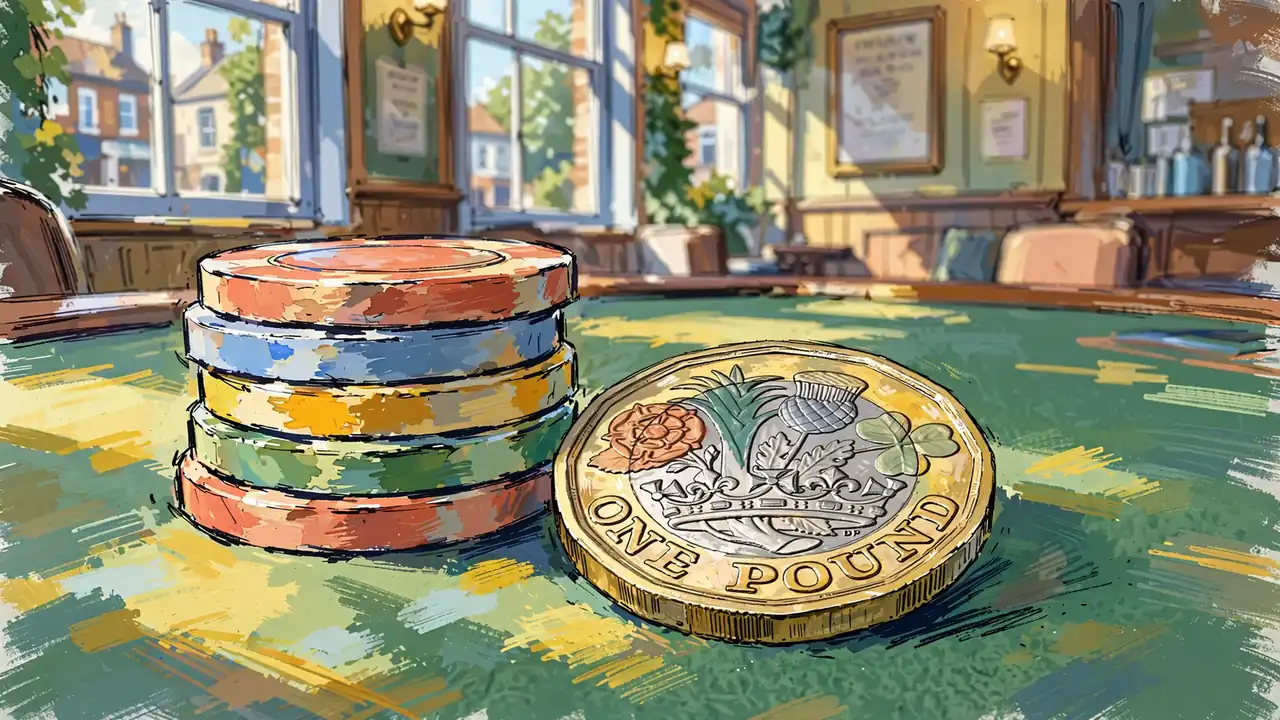
A £1 entry point is rare and may be available through one payment option without applying to the casino’s other cashier routes.
What a £1 Minimum Deposit Actually Means
A £1 minimum deposit is the smallest amount a casino will accept through its cashier under the conditions attached to that transaction. Some UK casinos do accept deposits at this level, but it is a rare threshold rather than a standard feature across the market. The figure describes an entry point for depositing money; it does not, by itself, establish that every payment route at the casino will accept the same amount.
That distinction matters because a cashier minimum can depend on the method selected. A site may accept a pound through one route while setting a higher minimum for another. As a result, a general statement that a casino has a £1 minimum needs to be read in context: it may refer to a particular payment option, not an unconditional minimum across the whole cashier. The amount shown before confirming a deposit is more informative than a headline description.
A specialist review reports that £1 is the lowest deposit tier found at UK casinos and that this tier is rare, with availability commonly associated with specific methods such as Boku or Payforit mobile billing. That report should be treated as a description of a limited tier, not as evidence that every casino offers it or that those methods are available at every operator. The central point is narrower: a one-pound cashier minimum exists, but it is not a dependable market-wide standard.
The wording can also obscure what the figure refers to. “£1 minimum” is a statement about the amount accepted for a deposit under stated conditions. It is not necessarily a promise that all account functions or payment choices begin at that amount. If the cashier presents different options, each may have its own terms. A threshold attached to one option cannot safely be assumed to apply to another.
This is why a low minimum deposit casino should not be assessed from a single promotional label alone. The relevant detail is the minimum displayed for the selected method at the point where a transaction is prepared. If the cashier gives a different amount from the site’s general description, the cashier’s method-specific condition is the practical one to note. The label may still describe a real £1 route, but it does not establish that every customer can use it in every circumstance.
£20 Minimum Deposit Casinos in the UK: How It Works
A £1 minimum also says nothing by itself about the wider value of an account. It identifies an unusually low amount accepted at deposit stage; it does not establish that the site has other features associated with a particular style of play, nor does it indicate how much money might be needed for other account activity. Those are separate questions. Keeping the definition narrow prevents the minimum from being mistaken for a broader promise about the casino.
The same caution applies to descriptions of the “best” £1 minimum deposit casinos. A low threshold is one attribute, not a complete basis for comparing operators. It does not show whether the £1 route is available through a preferred payment method, or whether the amount applies beyond that route. A claim about a £1 minimum is most useful when it specifies the cashier condition behind it rather than presenting the figure as an all-purpose measure.
In practice, the term is best understood as a conditional entry threshold: a casino accepts a deposit of one pound where its stated cashier rules allow it. Some UK casinos do; the tier is rare; and the available reporting links it to particular payment routes rather than to a universal rule. That definition avoids overstating what the figure proves. It establishes that £1 deposits are possible at some operators while leaving method-specific conditions to be assessed separately.
How £1 Deposits Compare with More Common Minimums
A £1 cashier minimum sits at the bottom of a wider range of entry thresholds. The contrast is clearest when it is compared with direct banking: one specialist review describes £10 as the typical minimum for that method, while noting that some operators set the threshold at £5 and others at £20. This is a reported pattern, not a fixed rule for every UK casino. The figures indicate why a £1 option can be materially lower than the amount required through another route at the same operator.
£2 Minimum Deposit Casinos in the UK: What to Know
The difference is not simply between casinos that accept small deposits and those that do not. A cashier minimum can depend on the payment method selected, so one operator may not have a single threshold that applies in every case. At many UK operators, the minimum is the same across the available methods. However, some set a higher floor for direct banking than for cards or e-wallets. A low figure shown for one method therefore cannot, by itself, establish the minimum for another.
This distinction matters when comparing a £1 deposit with the more common direct-banking figures described in the specialist review. The comparison concerns the amount accepted through a particular route, not necessarily an operator-wide minimum. If a cashier displays different thresholds by method, the lower option may not be available through direct banking. Conversely, a direct-banking minimum above £1 does not establish that every other method has the same floor.
A useful comparison therefore has two parts: the operator’s lowest cashier minimum and the minimum attached to the intended payment method. Those amounts may coincide, but the evidence allows for exceptions. Treating them as interchangeable can make a casino appear to offer a £1 entry point when the selected route requires more. It can also obscure a lower threshold available through another method. The cashier’s method-specific terms are what resolve that difference.
The range reported for direct banking also shows why a single benchmark should not be treated as universal. The specialist review gives £10 as its typical figure, alongside examples at £5 and £20. Those differences are meaningful for comparison, but they do not establish how any particular operator sets its cashier today. Minimums can be operator-specific, and the stated range should not be read as a guarantee that every casino falls within it.
For someone assessing online slots, the relevant comparison is still the deposit threshold, not a promise about how long a balance will last or what it will make possible. A £1 cashier minimum describes an amount an operator may accept under a stated payment condition. It does not, on its own, show that £1 is accepted through direct banking, or that every other cashier option begins at the same amount. Keeping the terms separate prevents the lowest advertised figure from being mistaken for a universal deposit rule.
£3 Minimum Deposit Casinos in the UK: What to Know
The phrase “lowest minimum deposit” can consequently refer to more than one thing. It might mean the smallest amount accepted by an operator through any listed method, or the minimum for a specific method such as direct banking. Those are not equivalent comparisons where thresholds differ. A casino may have a higher direct-banking floor and a lower threshold elsewhere; another may use one minimum across its payment methods. The distinction is about the structure of the cashier, rather than a general ranking of operators.
Nor does the lower threshold alone establish that an operator is the best, safest or most trusted choice. It answers a narrow question about the amount accepted at deposit. Those broader judgements require evidence beyond a comparison of cashier minimums. In particular, a £1 figure should be treated as a method-specific term unless the cashier makes clear that it applies across the operator’s payment options.
The most defensible comparison is therefore conditional: £1 is below the direct-banking levels reported in the specialist review, but an individual operator’s thresholds may vary by method. The review’s £10 figure and its £5 and £20 alternatives provide context, not a current rule for every casino. A cashier minimum is meaningful only alongside the payment route to which it applies.
The 2026 Bonus Rules for a £1 Deposit
A £1 deposit and a qualifying bonus deposit are not necessarily the same thing. A casino may accept a pound into the account while setting a higher threshold for a welcome offer. In that case, the payment can fund play without triggering the promotion. The cashier minimum therefore does not establish eligibility for a bonus; the offer’s own conditions determine that.
A specialist review of UK welcome offers reported qualifying deposits in the £5 to £10 range. That is a description of the offers reviewed, not a rule applying to every operator or promotion. The same type of review noted that some bonuses set a £10 qualifying deposit even where the cashier accepts £5. Against those thresholds, a £1 payment would fall short. The precise qualifying amount must be read in the terms for the specific offer, rather than inferred from the amount accepted by the cashier.
£4 Minimum Deposit Casinos in the UK: What It Means
Separate the deposit from the promotion
Bonus eligibility may depend on a minimum deposit, whether the promotion has been selected or claimed, and any other stated conditions. A payment accepted by the account does not, by itself, confirm that a welcome offer has been activated. If the qualifying amount is not met, the deposit and any promotional funds remain distinct: the account may contain deposited money without the bonus being added.
This distinction matters particularly when a promotion is presented alongside a low cashier minimum. The two figures answer different questions. The cashier figure concerns the amount accepted as a deposit; the qualifying figure concerns the amount needed to take part in the offer. A £1 minimum deposit casino can therefore accept a pound without making that payment eligible for a welcome deal.
Offer wording should also be checked for the qualifying deposit and the wagering condition together. A promotion may state a deposit threshold that exceeds the amount a player intends to pay, or attach conditions to bonus funds once credited. Neither the headline bonus nor the deposit threshold alone describes the full obligation. The terms should make clear what must be deposited, what funds are subject to wagering, and what restrictions apply to the offer.
The wagering limit changed in 2026
Some older bonus coverage reported wagering requirements of 30x to 65x the bonus value. Those figures describe terms reported in earlier specialist reviews; they should not be treated as the permitted standard for a current UK offer. Since 19 January 2026, the UK Gambling Commission has capped wagering requirements on bonus funds at 10x. A current gambling incentive cannot require more than that limit.
The distinction is important because a historical figure may still appear in older pages or descriptions, even though the applicable rule has changed. A current offer must be assessed against the limit in force from 19 January 2026, not against a previously reported range. If a promotion’s stated bonus wagering requirement exceeds 10x, that conflicts with the cap effective from that date.
Wagering conditions govern how much qualifying play is required before bonus-related funds can be withdrawn. They are not the same as the initial deposit requirement. Meeting a deposit threshold may make an offer available, but does not remove its wagering condition; conversely, a low cashier minimum does not make the wagering requirement lower. The deposit, bonus amount and wagering rule must be considered as separate parts of the terms.
No minimum deposit casinos in the UK: £1 explained
Free spins also have conditions
Free spins do not necessarily remove the deposit threshold or the wagering rules. A specialist review reported free-spin packages linked to £1 deposits ranging from 10 to 100 spins. This is a reported range from that review, not a guarantee that a particular casino currently offers spins at that level. Eligibility and the number of spins depend on the promotion’s own conditions.
Any winnings from spins may also be subject to wagering. Older specialist reviews reported requirements of 30x to 65x the total winnings from free spins. Those reported figures should not be read as current permissible terms: from 19 January 2026, the 10x cap on wagering of bonus funds applies to gambling incentives. The promotion’s current terms need to explain how spin winnings are treated and what wagering applies.
Spin offers can carry other conditions, including an expiry period and restrictions on eligible games. These affect whether the spins can be used and how resulting winnings are treated, but they do not alter the difference between a cashier minimum and a qualifying deposit. A £1 deposit may satisfy the first while failing the second.
For a £1 payment, the relevant checks are therefore straightforward: whether the cashier accepts it, whether the promotion sets a higher qualifying deposit, and what wagering condition applies to any bonus or spin winnings. The 2026 limit is a useful test of current wagering terms, while older reported ranges should be understood as historical descriptions rather than a guide to offers now permitted in the UK.
Which Payment Methods Can Support a £1 Deposit?
A payment method’s ability to process a small transaction is not the same as a casino accepting that amount at its cashier. Debit cards and some e-wallets can support a £1 payment, but the operator’s rules and the limits attached to the chosen method both matter. The same account may therefore show different minimums depending on how the deposit is made.
Visa and Mastercard debit cards are accepted at almost all UK casinos and can be used for low-value deposits. That does not guarantee that every casino will accept £1 by card: the cashier may set a higher minimum, or the card transaction may be subject to conditions imposed by the issuer. The amount shown on the deposit screen is the relevant figure for that transaction, rather than the lowest amount the card could technically process elsewhere.
Online Casinos With No Sister Sites in the UK
The distinction is important when comparing an online casino with a £1 minimum deposit in the UK. A casino might support £1 through one option but require more through another. Conversely, a card that is capable of making a £1 payment does not establish that a particular casino’s cashier accepts it. The operator’s listed minimum for the selected payment route is what determines whether the deposit can proceed.
E-wallets can also be suitable for small deposits, provided the wallet is funded appropriately. For UK gambling, an e-wallet used to deposit must be funded by debit rather than credit. Wallets that allow credit-card funds to be used for gambling cannot be accepted for that purpose. As with cards, the e-wallet provider’s ability to process a small amount does not override a higher minimum imposed by the casino.
Direct banking is another permitted route, using a bank account rather than a credit card. Its availability and cashier conditions are specific to the operator and payment option. A low cashier minimum advertised for one method should not be assumed to apply to direct banking as well. The deposit screen should identify the accepted route and the minimum attached to it before a payment is submitted.
Prepaid vouchers work differently because the value bought is not necessarily the amount deposited in one transaction. Paysafecard is sold in fixed denominations of £5, £10, £25, £50 and £100. A single voucher can be used to fund several smaller deposits, where the casino accepts the voucher method and the account balance remaining on it permits this. Thus, a voucher with a value above £1 may still be usable for separate low-value deposits; it does not mean that the casino has accepted a £1 voucher.
The same distinction applies to any payment route: the amount available in a card, wallet, bank account or voucher is separate from the cashier minimum. A payment option may be displayed but not support every deposit amount, and a method that permits a small transaction may not be offered by every casino. Before proceeding, the method and the displayed minimum need to be considered together.
£5 Minimum Deposit Casinos in the UK: How It Works
The UK’s credit-card gambling ban, introduced in 2020, means casino deposits cannot be made using credit cards. The permitted funding routes include debit cards, e-wallets funded by debit and bank accounts. This restriction concerns the source of gambling funds, not merely the name of the payment service: a wallet is not suitable if it allows credit-card funds to be used for gambling.
For a £1 deposit, the practical check is therefore method-specific. The cashier should show that the selected route accepts the amount, and the underlying funding source must comply with UK rules. Card acceptance across the market does not establish a universal £1 limit, while a voucher’s fixed purchase value does not prevent it from being divided across smaller deposits. A casino’s general minimum and the conditions for each payment option need to be read together, rather than inferred from the method alone.
Playing for Real Money with a Small Balance
A £1 balance can be used for real-money slot play where the game and cashier permit it, but it provides little room for repeated spins. Many slots accept stakes of 10p to 20p per spin. At those stake levels, £1 covers ten spins at 10p or five at 20p if there are no wins; any winnings change the balance, while losses reduce the number of spins available.
Those figures describe the stake, not a guaranteed playing time or outcome. A sequence of spins may use the balance quickly, and a win does not ensure that the account will meet the casino’s cash-out conditions. The practical value of a small deposit therefore depends not only on the slot’s available stakes but also on what happens to any resulting balance.
Withdrawal terms can create a gap between depositing a small amount and being able to withdraw. A specialist review reports minimum withdrawal thresholds of £10 to £20 at many UK casinos. That range should be treated as the figures reported by that type of source, not as a fixed rule for every operator. Some casinos set a withdrawal minimum above £1, so a balance of that size may be insufficient for a cash-out request.
Anjouan Casino Licence in the UK: Legal Position
The cashier’s withdrawal rules need to be considered separately from the amount accepted for deposit. A low entry balance does not establish that the same amount can be withdrawn, nor does it show what minimum applies to a particular account. If play produces a balance below the operator’s withdrawal threshold, the funds may remain in the account until the threshold is met, subject to the casino’s terms. The applicable threshold should be confirmed in the cashier or withdrawal rules before play.
This distinction matters for a real-money £1 minimum deposit casino in the UK: the deposit amount describes what can be placed into the account, while the withdrawal minimum governs access to funds later. A £1 starting balance may be enough to try a slot at its lower stake, but it is not evidence that £1 can be cashed out. The rules for a specific casino determine whether a resulting balance is withdrawable and what conditions apply.
For mobile play, the same basic arithmetic applies when a slot is available on a phone: the stake is deducted from the account balance, and a small balance can support only a limited number of spins at the stated stake. Using a mobile device does not, by itself, change the casino’s withdrawal threshold. The key practical checks are the game’s stake options and the account’s cash-out terms, rather than the size of the initial deposit alone.
£1 Casinos and Gamstop: What the Available Evidence Shows
A £1 cashier minimum and Gamstop status are separate questions. Evidence that a casino accepts a small deposit does not establish whether it participates in Gamstop, and a description such as “not on Gamstop” does not verify either its operating status or the conditions attached to its accounts. No particular £1 casino’s Gamstop status can be confirmed here.
For the British market, the central regulatory test is whether an operator holds the relevant UK Gambling Commission licence. Remote gambling operators offering services to customers in Great Britain must hold that licence, wherever the business is based. A site described as outside the UKGC system is not thereby shown to be a lawful UK casino: online gambling in the UK is legal only through licensed and regulated sites. The Gambling Act 2005 applies in England, Wales and Scotland; Northern Ireland is outside that Act.
The label “not on Gamstop” should therefore not be treated as a substitute for checking an operator’s regulatory position. Nor does a £1 minimum deposit, by itself, demonstrate that a site has any particular relationship with Gamstop. Those are distinct attributes, and the available information does not link a named £1 operator to a confirmed Gamstop status.
Age and payment rules remain relevant regardless of how a site is described. UK players must be at least 18. The UK credit-card gambling ban, introduced in 2020, means gambling deposits must be funded through debit cards, bank accounts, or e-wallets funded by debit cards; credit cards cannot be used for gambling deposits. A claim about Gamstop does not change these restrictions.
Accordingly, claims that a particular £1 casino is “not on Gamstop” should not be read as evidence that it is licensed, unlicensed, or suitable for UK play. The available evidence supports no operator-specific conclusion on Gamstop participation. The distinction is important: a low cashier minimum identifies a deposit condition, while licensing and Gamstop status require separate verification.
PayPal and Other Small-Deposit Payment Questions
A PayPal option in a casino cashier does not, by itself, establish that a £1 payment will be accepted. The cashier minimum and the conditions attached to each payment route need to be considered together. At a given UK operator, the minimum is often shared across payment methods, but some casinos set a higher threshold for direct banking than for cards or e-wallets. A displayed £1 minimum therefore needs to be checked against the specific method selected.
PayPal cannot be treated as a confirmed £1 deposit option across UK casinos. Availability and the permitted transaction amount depend on the operator’s cashier terms; the payment method’s presence is not evidence that its minimum is £1. The same distinction applies to other e-wallets. For gambling deposits, an e-wallet must be funded in a way that complies with UK rules, which exclude credit-card funding.
Fees can also change the effective cost of a small payment. A specialist review has reported flat transaction charges of £1 to £3 from some payment providers. That is a report about particular providers, not a fee that can be assumed for every transaction. Where such a charge applies, it may equal or exceed the intended deposit, so the amount credited to the casino account may not reflect the full sum paid.
The relevant details are the minimum shown for the chosen method, any provider charge, and the amount the operator confirms will reach the account. These terms should be read before submitting a transaction rather than inferred from a general statement that the casino accepts PayPal or another e-wallet. Debit cards, e-wallets funded by debit, and bank accounts are permitted deposit sources within the UK regulatory framework; credit cards are not. A small-deposit payment is therefore defined not only by the casino’s cashier threshold, but also by the conditions of the selected payment route.
Setting a Limit Before a Low-Value Deposit
A small opening payment does not remove the need for safeguards. In Britain, a new customer must be prompted to set a financial limit before making a first deposit, and account-level controls must remain accessible. This applies to a low-value deposit just as it does to a larger one: the amount paid into an account is not a substitute for deciding how much gambling spend is affordable.
Age checks are another prerequisite. UK players must be at least 18, and a licensed operator must verify a customer’s age before allowing a deposit. A low cashier minimum does not change that requirement or make an account available to someone below the legal age.
A financial limit is most useful when it is set before funds are added, rather than treated as a response to losses. Its purpose is to define a boundary for spending; it does not establish that gambling is affordable or ensure that losses will be recovered. Account controls should make it possible to manage that boundary after registration as well.
The responsible-gambling framework is therefore relevant even where the amount at stake initially appears modest. A minimum-deposit figure describes what an operator may accept at the cashier, not what a player should spend. For a UK-licensed casino, age verification and a pre-deposit financial limit are safeguards that apply before play begins, regardless of the size of the first payment.
Does “£1” Mean One Pound or a Different Deposit Tier?
Here, “£1” refers to the amount paid into the casino account: one pound sterling, not a separate currency unit or an informal label for a higher tier. Some UK casinos do accept a deposit of that size, although the cashier’s stated minimum only describes the smallest amount accepted for a deposit.
That figure does not establish how much is needed to play, nor does it determine what can be withdrawn. A £1 deposit may be enough to fund an account, but any resulting balance is subject to the operator’s game and withdrawal rules. The deposit threshold and the withdrawal threshold are distinct conditions.
A specialist review reported minimum withdrawal thresholds of £10 to £20 at many UK casinos. That range should be treated as a reported finding, not a universal or permanent rule: each operator sets its own conditions, and those terms can change. Where a withdrawal minimum exceeds the balance available, the account may not yet meet the stated threshold for cashing out.
The wording “one-pound minimum deposit” therefore concerns the cashier’s entry point alone. It should not be read as a promise that a one-pound balance can be withdrawn, or that it will support a particular amount of play. Those outcomes depend on separate account terms.
How to Verify a Casino’s £1 Cashier Minimum
A casino advertising a low deposit tier does not necessarily accept £1 at the cashier. The decisive detail is the minimum shown for the selected payment method before a transaction is submitted. Promotional eligibility is a separate condition: an account may accept a £1 deposit while requiring a larger payment to activate an offer.
A specialist casino review recorded six UKGC-licensed casinos as accepting genuine £1 minimum deposits. Within that review’s list, NetBet was the only UKGC-listed casino identified with a £1 cashier minimum. This is a finding about that list, not a guarantee that the threshold remains available for every customer or payment route.
Verification therefore depends on the cashier’s stated minimum, rather than a headline describing a low deposit or a bonus. The operator’s current payment screen should show whether £1 can be entered and accepted using the chosen method. The account’s promotional terms should be checked separately, since a qualifying deposit may exceed the cashier minimum.
Regulatory status is another distinct check. A casino serving customers in Great Britain must hold the relevant UK Gambling Commission operating licence; a low cashier threshold alone says nothing about licensing. A £1 minimum is confirmed only when the licensed operator’s cashier accepts that amount for the selected route. A listing or promotional description can identify a candidate, but the live cashier terms determine whether the deposit is actually available.
What is the best £1 minimum deposit casino in the UK?
NetBet is the only UKGC-listed casino identified with a £1 cashier minimum. That does not establish that it is the best overall.
What is the minimum deposit at UK casinos accepting direct banking?
The typical minimum is £10, though some operators set it at £5 or £20. Check the cashier’s minimum for direct banking, as it can differ from other payment methods.
Which UK casinos accept a £1 deposit?
NetBet is the only UKGC-listed casino identified with a £1 cashier minimum.