

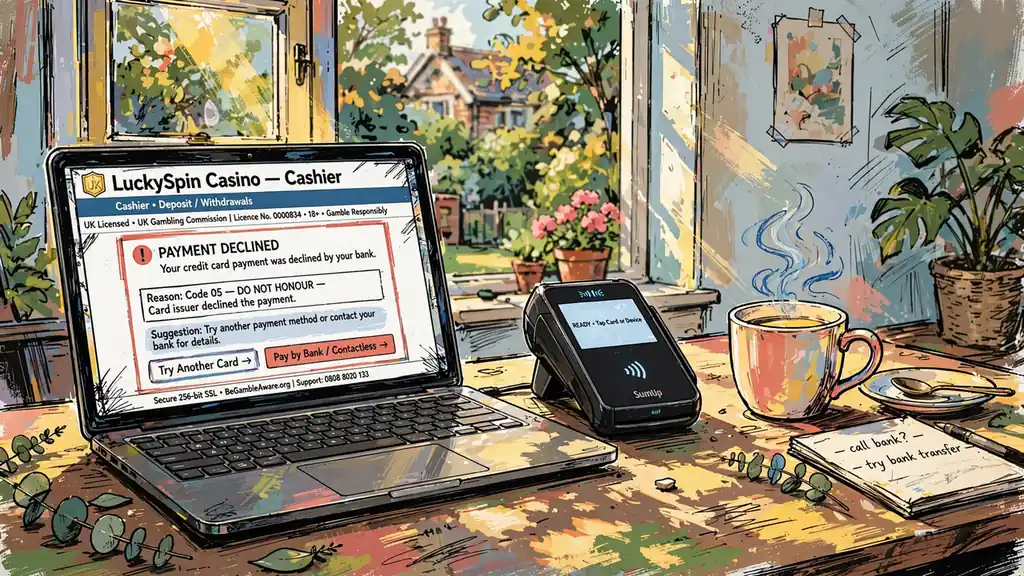
The UK credit-card gambling ban sets the boundary for casino payments, while card eligibility and other funding options depend on the payment method.
Why UK-Licensed Casinos Do Not Take Credit Cards
The UK credit-card gambling ban sets a clear boundary for remote gambling licensees: credit-card payments for gambling cannot be accepted at UK-licensed casinos. The restriction is not a voluntary payment preference or a temporary cashier setting. It is a regulatory rule that applies to licensed operators serving the British market.
The ban took effect on 14 April 2020. Since then, it has not been relaxed. A casino operating under a UK Gambling Commission licence therefore cannot treat a credit card as an eligible way to fund gambling, even if a card issuer or payment screen appears to make a transaction technically possible. The operator’s obligation is to comply with the gambling rules, not simply to process whatever a payment provider can authorise.
This restriction is specific to credit-card payments for gambling. It should not be confused with a general prohibition on card payments or with the rules governing every kind of payment card. In particular, the fact that UK casinos may accept other card products does not alter the ban on credit cards. The relevant distinction is the nature of the payment product and its use for gambling.
The regulatory context matters because remote gambling operators selling into the British market must hold a Gambling Commission licence, wherever they are based. Legal online gambling in Great Britain is therefore tied to the UK licensing system. A business cannot avoid the credit-card restriction merely by operating from another country while offering real-money gambling to British customers.
The ban also forms part of the conditions under which licensed remote gambling is provided. It is not a rule that individual casinos can waive for a particular customer, nor can an operator make an exception because a card transaction has been approved elsewhere. The prohibition applies at the point where a licensed gambling service accepts payment for gambling.
UK Wirecard Casino Acceptance: What Can Be Verified
The date is useful when assessing older descriptions of casino payment policies. Material published before the rule came into force may describe arrangements that are no longer compatible with the current UK framework. Likewise, a general statement that a site accepts cards does not itself establish that credit cards are accepted for gambling. The licensing rule remains the controlling standard for UK-licensed casinos.
The distinction between a legal operator and a payment provider is also important. A payment service may support card transactions in other settings, but that does not give a UK casino permission to accept a credit-card payment for gambling. The operator remains responsible for complying with the restriction when it provides gambling to customers in the regulated market.
Accordingly, the central point is regulatory rather than technical: UK-licensed casinos do not take credit cards for gambling because the UK ban has applied since 14 April 2020 and remains in force. This baseline explains why any description of a casino’s payment facilities must be read in light of the product-specific restriction, rather than as evidence that every type of card can be used.
What a Credit-Card Listing Says—and Does Not Say
A Visa or Mastercard logo identifies a card network, not the type of card attached to it. The same network can appear on debit and credit cards, so a payment-method list that names either brand does not, by itself, show that every card carrying that logo is accepted. In the UK casino context, that distinction matters: debit cards are commonly accepted, but a credit card cannot be treated as an eligible gambling payment merely because its network is displayed.
This can make a listing headed “cards” or “Visa and Mastercard” easy to misread. It may describe the network supported for a particular transaction rather than spell out which card products are eligible. A debit card linked to a bank account and a credit card issued on a borrowing facility are different products, even where both display the same logo. The logo alone does not resolve that difference.
Credit card acceptance
Prohibited for UK-licensed casinos
Effective date
14 April 2020
Primary alternatives
Debit cards, e-wallets, bank transfers
Some specialist casino review pages list Visa and Mastercard as payment methods. That information is not enough to establish which products can currently be used by a customer in the UK. Availability can depend on the operator’s current cashier, and eligibility is a separate question from whether a network appears in a general payment summary. The cashier’s displayed options are the relevant place to check a specific card product; a broad listing should not be read as confirmation that a credit card is accepted.
Reading card references carefully
The wording of a payment page can indicate how specific its information is. A brand name alone is broad. A reference to debit cards is more precise about the product type, though current availability still needs to be confirmed at the casino. Where a page groups cards under a single logo, it may leave the product distinction unstated. That ambiguity should not be resolved by assuming that the card will work.
A useful reading separates three questions:
- Which card network is named?
- Does the information identify debit cards, rather than cards generally?
- Is the specific product shown as available in the casino’s cashier?
These are not interchangeable checks. A network logo answers the first question only. A general statement that debit cards are accepted addresses the product category, but does not prove that every debit card is enabled at every operator. The cashier can show whether a method is currently offered, but a card’s logo still does not turn a credit product into an eligible debit product.
The distinction also explains why a page titled around casinos that accept credit cards may not describe a lawful or usable credit-card option at a UK-licensed casino. The wording may reflect broad card branding or an imprecise category label, rather than verified acceptance of credit-funded gambling. A listing’s title is not stronger evidence than the payment details it actually gives.
What can be established from the listing
Visa and Mastercard are commonly accepted as debit-card networks at UK casinos. That supports a limited conclusion: debit cards using these networks are a familiar payment category. It does not support the wider claim that all Visa or Mastercard products are accepted, nor does it establish that credit cards can fund a gambling account.
The same care applies when comparing several casino pages. A logo repeated across listings may look like confirmation, but repetition does not add detail about the card product. One page may use “Visa” as shorthand for a supported debit-card route, while another may simply reproduce a network icon without specifying the eligible card type. Without product-level wording, the label remains incomplete.
For a credit-card casino listing to be meaningful in the UK, it would need to distinguish the card product and the transaction’s eligibility, rather than relying only on a familiar brand mark. At a UK-licensed casino, a credit-card logo or broad card label should not be taken as evidence that credit can be used for gambling. The more reliable interpretation is narrower: card-network names identify brands; debit-card acceptance is a separate claim; and current product availability must be checked in the operator’s cashier.
Payment Methods Available at UK Casino Sites
For UK casino accounts, the practical alternatives to credit cards include debit cards, bank-based payments, e-wallets and prepaid vouchers. Availability is not uniform: a method may appear at one site’s cashier and be absent at another. A payment logo or general list of options does not establish that every account can use that method.
Debit Cards
Visa and Mastercard debit cards are commonly accepted as they draw on bank funds.
E-wallets
Options like PayPal, Skrill, and Neteller provide alternative electronic payment routes.
Bank Transfers
Open banking and bank-based services support direct transfers from a bank account.
Prepaid Vouchers
Services like Paysafecard allow deposits without using a debit card.
Debit cards
Visa and Mastercard debit cards are commonly accepted at UK casinos. They are not credit cards: the payment draws on funds held in a bank account rather than borrowing against a credit facility. The distinction matters because a card’s network logo alone does not identify the type of product or establish that the cashier will accept it. Current availability and card eligibility need to be checked at the individual site.
Bank-based payments
Open banking services and bank transfers are alternatives to card payments. A specialist review reports that these methods can support instant deposits and fast withdrawals at many sites; that description is not a guarantee of speed or availability at every operator. The cashier’s available options and the operator’s payment terms determine whether a particular bank route can be used.
These methods are distinct from e-wallets. A bank-based payment can connect a casino transaction with a bank account, while an e-wallet is a separate payment service. The names and functions shown in a cashier should therefore be read as specific routes, not as interchangeable labels for all electronic payments.
E-wallets
PayPal is a recognised option at some casino sites. A specialist review describes it as popular for speed and convenience, while also noting that a deposit made through it may not qualify for a promotion. Bonus terms can differ between operators and offers, so eligibility should be checked against the conditions attached to the specific promotion.
Skrill and Neteller are offered at some sites. A specialist review identifies Skrill as one of the more common deposit methods at UK-facing casinos in 2026, but this does not mean that every casino accepts it. The same type of review reports that Skrill and Neteller are often excluded from promotions. The cashier and the relevant bonus terms are the useful sources for confirming whether a method is available and whether it affects an offer.
Casino Sites That Accept Jeton in the UK
Apple Pay is another deposit option at some UK Gambling Commission-licensed casinos. Its presence should not be taken to mean that it is available at every licensed site or that it supports every account or transaction type.
Prepaid vouchers
Paysafecard is a prepaid voucher for deposits only. It can provide a way to add funds without using a debit card at the point of deposit, but it should not be treated as a general-purpose route for receiving withdrawals. The deposit-only distinction is important when comparing it with methods that may be presented for more than one transaction type.
Across these categories, the cashier is the operative guide to what a casino currently supports. A method’s presence elsewhere, or its general availability in the UK, does not establish that it can be used with a particular account. Promotion terms also matter: a payment option can be available for deposits while remaining ineligible for a particular bonus.
Deposits, Withdrawals and the Return of Funds
A deposit and a withdrawal are separate stages, so the time taken to fund a casino account does not predict how quickly money will be paid out. A payment may be authorised promptly at the deposit stage, while a withdrawal must pass through the operator’s checks and payment processing before it reaches the account. The displayed status of a withdrawal can therefore refer to casino processing rather than the time required for the receiving provider or bank to deliver the funds.
A card deposit can often be instant, whereas a withdrawal may take several business days to process.
A specialist casino payment review reports that a card deposit can be instant, while a payout may take several business days. This is an illustration of the difference between the two stages, not a timetable that applies to every casino or card product. The actual route and the operator’s stated processing times matter; neither the deposit experience nor a general description of a payment method establishes when a particular withdrawal will arrive.
The casino’s internal approval is part of the withdrawal process. A specialist review of casino payment procedures notes that this stage may take longer for a first withdrawal when verification is still being completed. KYC checks can require the operator to confirm account information before releasing funds. Once approved, the payment still has to travel through the relevant payment provider or banking system. These are distinct steps, and a delay at one stage should not automatically be read as a delay at another.
The return route is also shaped by anti-money laundering controls. UK rules generally require a payout to go back to the original payment source. This is often described as a closed-loop approach: deposits and withdrawals are linked, rather than treated as unrelated transfers. The aim is to make the movement of gambling funds traceable and to reduce the risk that an account is used to move money through a different channel.
Casinos That Accept Citadel in the UK: What to Check
As a result, a withdrawal method cannot be assumed to be freely interchangeable with the method used to deposit. Where more than one payment source has been used, the operator may have to consider how the funds should be returned under its procedures and applicable requirements. If the original source cannot receive the payment, an alternative route may involve additional checks; the available process depends on the operator and the payment arrangements in place.
Withdrawal estimates should therefore be read as stage-specific information. A stated processing period may cover the casino’s review, the transfer after approval, or both. A bank transfer’s delivery can also be affected by banking schedules and conversion, so a casino approval notice is not necessarily confirmation that the money is already available in the receiving account. The cashier or withdrawal information should make clear which part of the process an estimate describes.
For a UK casino account, the practical sequence is deposit authorisation, any required account review, operator approval of the withdrawal, and delivery through the payment route. A quick first step does not remove the later checks, and an approved payout is not the same as a completed transfer. These distinctions explain why deposit speed and withdrawal speed can differ without implying that the same timing applies across casinos or payment providers.
Can a Credit Card Be Used for Online Gambling in the UK?
No. A credit card cannot be used to fund gambling at a UK-licensed online casino. Remote gambling licensees are not permitted to accept credit-card payments for gambling, so a casino cashier may not lawfully treat a credit card as an eligible deposit method.
Prohibition
UK-licensed casinos are not permitted to accept credit-card payments for gambling.
The restriction applies to online casino gambling generally, not only to a particular game. A credit card therefore cannot be used to deposit money for online slots at a UK-licensed site either. The rule remains in force; the regulator introduced the ban on 14 April 2020 and has not relaxed it.
This is a restriction on the source of gambling funds, rather than a statement that every payment card is unusable. A payment method must be eligible for gambling under the rules and accepted by the individual casino. The practical distinction is between a credit-card payment and another permitted way of funding an account. The payment options presented in a casino’s cashier are the relevant place to establish what that operator supports.
The distinction matters because the word “card” does not, by itself, identify the type of payment. A credit card and a debit card can look similar, but they do not have the same eligibility for gambling payments in Britain. A card’s brand or appearance is not enough to establish whether it can be used; its underlying product and the casino’s payment controls matter. The prohibition concerns credit-card payments for gambling, not every transaction made with a card.
Nor does the rule depend on whether a deposit is small, whether the account is new, or whether the money is intended for a particular casino game. It is not an operator preference that can be overridden by choosing another cashier option or asking customer support to process the card manually. A UK-licensed casino cannot make an exception to the restriction.
Casino Sites That Accept EcoPayz in the UK
For online gambling in the UK, the relevant distinction is between a licensed casino and a site outside the UK regulatory system. A casino serving British customers must hold the appropriate Gambling Commission licence. The answer above concerns UK-licensed sites, which are subject to the domestic rules; the presence of a credit-card button on another website does not establish that it is a lawful option for gambling with a UK-licensed operator.
If a deposit is declined, that does not mean the restriction has changed or that the same credit card can be tried through a different payment route. The casino’s eligibility checks determine whether a payment can be accepted, and credit-card funding for gambling remains prohibited. Any permitted alternative must be assessed on its own terms rather than treated as a way to make a credit card acceptable.
In short, a credit card cannot be used to deposit at a UK-licensed online casino or to fund online slot play there. The restriction is not a temporary cashier limitation: it is a continuing requirement for remote gambling licensees.
Card Deposits, Third-Party Wallets and Payment Eligibility
A payment route has to be assessed as a whole: the card used to add money to a wallet, the wallet’s rules for gambling transactions, and the casino’s cashier must all permit the intended use. Moving funds through another service does not make an otherwise ineligible credit-card payment acceptable.
Remote gambling licensees cannot accept credit-card payments for gambling, including payments routed through a money service business. The same restriction applies where a wallet allows credit-card funds to be used for gambling. A wallet is therefore not a compliant workaround simply because the casino receives a payment under the wallet provider’s name rather than directly from a card.
Attention Using a third-party wallet does not bypass the restriction if the underlying funds are from a credit card.
This distinction matters because a wallet balance may contain funds added by different methods. Where the wallet permits credit-card funds to be used for gambling, a payment from that wallet can still fall within the restriction. The relevant issue is not only which logo appears in the casino cashier, but also whether the underlying route can carry credit-card funds into gambling.
A payment method’s presence on a general list is not confirmation that it is available for every account or transaction. A specialist review listing Visa and Mastercard, for instance, cannot establish current UK availability or whether a particular card product will be eligible. Those details need to be checked in the operator’s cashier, where the available methods and any applicable restrictions are presented for the account.
The distinction between debit and credit products is important. Visa or Mastercard branding alone does not identify the funding source or establish that the card can be used for a particular gambling payment. If a cashier lists a card network, that listing should not be read as acceptance of every product carrying that mark. The product type and the permitted route still matter.
A similar check applies to third-party wallets. A cashier may display a wallet without confirming that every way of funding it is permitted. The wallet provider’s terms and the casino’s payment conditions determine whether the route is eligible; a credit-card-funded balance cannot be treated as acceptable merely because the final transfer is labelled as a wallet payment.
Payment eligibility can also affect how funds are handled later. Returning money to its original source is a common anti-fraud and anti-money-laundering control. Where the original route cannot receive a payout, an alternative may require additional verification rather than being available automatically. This makes it important to distinguish a route that can make a deposit from one that can support the account’s wider payment process.
Casinos That Accept Upaycard in the UK
Descriptions such as “not on GamStop” do not alter these payment requirements. For gambling offered to customers in Great Britain, the operator must hold the relevant UK Gambling Commission licence; an offshore site without that licence is outside the UKGC system. Neither an alternative label nor a different payment intermediary changes the restrictions applying to credit-card funds.
Deposit Minimums, Limits and Account Controls
Deposit thresholds and account limits are separate controls. A minimum is the smallest amount a cashier will accept in a transaction; a maximum caps the amount that can be deposited. Neither should be assumed to apply uniformly across every payment route or customer account.
A specialist casino review places commonly stated minimum deposits in the £10–£20 range, with the selected payment method affecting the threshold. This is a reported range, not a fixed UK-wide rule: the amount shown by an individual casino may differ. A listing that describes a low minimum therefore needs to be checked against the cashier’s current terms before an account is funded.
Maximums can be set per transaction, per day or per month. A specialist review reports that these caps vary with both payment method and account status. The practical ceiling may therefore depend on the route selected and the account’s circumstances, rather than on one figure applying to all customers. The cashier or account terms are the relevant place to confirm the applicable cap; a general description of a casino’s limits cannot establish the amount available for every transaction.
Regulatory Limits
Operators must provide financial limit controls at the account level for customer protection.
Financial limits also have a regulatory role beyond the cashier’s transaction caps. UK Gambling Commission rules require remote gambling operators to invite new customers to set a financial limit before they make their first deposit. Operators must also make account-level limit controls accessible, so that limits can be managed through the account rather than treated solely as a payment-provider restriction.
These controls should not be conflated. A payment method’s maximum governs what can pass through that route, while an account-level limit is a gambling-control setting. The applicable deposit cap and the customer’s own financial limit may both affect whether a transaction can proceed. A low minimum does not indicate a suitable spending level, and a high payment ceiling is not a recommendation to deposit more.
For a UK casino account, the relevant figures are those displayed for the chosen payment route and account, alongside the limit settings available within the account. They may change with the method or account status, so a figure taken from a general review should be treated as indicative rather than as a guarantee for a particular transaction.
Keeping Payment Details and Account Ownership Consistent
A payment route is easier to reconcile when its account holder matches the name and details on the casino account. Consistent ownership information reduces the chance that a transaction is delayed by a basic mismatch or needs further checks. This is a practical account-security measure, not a way to make an otherwise ineligible payment method acceptable.
Casinos That Accept E-checks in the UK: What’s Verified
For a credit card casino UK search, ownership checks do not change the payment restriction: UK-licensed casinos cannot accept credit-card payments for gambling. The relevant distinction is between the payment method and the identity of the person using it. A debit card, e-wallet or bank account may be listed in a cashier, but the name attached to that route still matters. A payment method in someone else’s name can create questions about who controls the funds and whether the account holder authorised the transaction.
A straightforward arrangement is to use one named account consistently for deposits and withdrawals, where the operator supports that route. This can make the relationship between the casino account and payment source clearer. Using another person’s card or account instead may complicate ownership checks, even when the account holder has given permission. Permission alone does not establish that the casino accepts the arrangement.
The same principle applies when personal details change. Differences in names or account information can make a transaction harder to verify, so casino account details and payment records should accurately identify the same customer. If a mismatch arises, the operator may request clarification or evidence before proceeding. No specific outcome can be assumed across all operators; payment terms and verification procedures vary.
This is also why a payment logo is not enough to establish that a particular route is suitable. For anyone asking whether credit cards are allowed at UK online casinos, consistent account ownership does not create an exception to the ban. The cashier’s current terms determine which eligible payment routes the operator supports, while matching account details help reduce avoidable friction within those rules.
Do
- Use a debit card linked to a bank account
- Ensure account ownership matches payment details
- Check the casino cashier for current availability
Don’t
- Attempt to use a credit card for deposits
- Assume a network logo implies credit acceptance
- Use a payment method in someone else’s name
Payment Fees and Currency Conversion
The cost of a casino payment cannot be assessed from a single fee label. A specialist payment review identifies several possible components: a charge imposed by the casino, a fee from the payment provider, a bank or card-issuer charge, currency-conversion costs, and network fees. Which of these apply depends on the transaction and the organisations handling it; a method described as free by one party may still carry a cost elsewhere in the payment chain.
Currency is a separate consideration. If the casino account and the payment account use different currencies, the amount converted may not match a simple reference-rate calculation. A specialist payment review notes that the exchange-rate spread—the difference between the rate applied and a reference rate—can exceed a visible flat fee. The fee shown before confirmation is therefore not necessarily the full cost of a transaction.
For UK accounts, the account currency should be confirmed before the first transaction. The supplied casino pages state that GBP is supported, but that does not establish that every account is denominated in pounds or that conversion will never occur. The relevant comparison is the currency displayed in the account and cashier, alongside any rate or conversion charge shown by the payment provider or bank.
There is no universal lowest-fee method. A meaningful comparison uses the same transaction amount and includes casino charges, provider fees, any issuer or bank fee, the exchange-rate spread, and network costs where applicable. A fixed charge may weigh more heavily on a smaller transaction, while a percentage-based conversion cost can produce a different result as the amount changes. These are cost structures, not a basis for naming one method as cheapest in every case.
The cashier’s displayed terms and the payment provider’s own fee information are therefore more useful than a general claim that a method is free. If the rate, fee or account currency is unclear, the total cost cannot be established from the payment-method label alone.
Casino Payments in the UK: Deposit and Withdrawal Options
Playing Online Slots Without a Credit Card
Online slots at UK-licensed casinos follow the same credit-card restriction as other forms of remote gambling. Credit-card payments for gambling are not permitted, whether a card is entered directly or used through a payment route that passes credit-card funds to the casino. The restriction has applied since 14 April 2020 and remains in force. It therefore does not depend on the game being a slot rather than another casino game.
The payment rule does not prevent slot play funded by an eligible non-credit method. However, a payment option being available for other casino activity does not by itself establish that it can be used for a particular slot account or transaction. The casino’s cashier determines which methods are enabled, while the product’s rules govern how the game can be played. These are separate conditions: payment eligibility does not override the rules on slot features.
British online slots also have specific play requirements. Autoplay is banned, so spins cannot be set to run automatically in succession. Each spin must last at least 2.5 seconds. These restrictions apply to online slot play independently of the payment method and are not removed by choosing a debit card, e-wallet or other eligible route.
A slot interface may offer controls that alter the pace or presentation of play, but it cannot lawfully provide autoplay or spins shorter than the required duration. The relevant standard is the actual spin cycle, not simply the speed at which a player can click or the visual style of the game. A fast animation should not be taken as evidence that the underlying spin falls below the permitted duration.
Accordingly, the answer to whether slots can be played with a credit card at a UK-licensed casino is no. The distinction is between the prohibited funding source and the rules governing the slot itself: using an eligible alternative does not change the ban on autoplay or the minimum spin duration.
Why must withdrawals return to the deposit method?
Returning funds to the original payment source is a common anti-fraud and anti-money-laundering control. An alternative route may require additional verification.
What is the fastest withdrawal method for UK casinos?
PayPal, open banking services and debit cards linked to fast payout systems are generally among the quickest options. Actual speed also depends on the casino’s approval process and whether your account is verified.
Why can a fast payout casino still delay my withdrawal?
The casino must approve the withdrawal, and first payouts may take longer while verification is completed. An account that is not fully verified can also affect the speed.
What is the current minimum deposit?
Minimum deposits usually start at £10–£20, depending on the payment method.
Which method has the lowest fees?
There is no universally lowest-fee method. Compare casino and provider charges, any currency-conversion spread, and network costs for the amount you plan to transfer.
Are fast casino withdrawals guaranteed?
No. Withdrawal speed depends on the casino’s approval process and whether your account is fully verified.